Make your online therapy practice feel human
Alchely is the platform that adapts to the way you work, not the other way around: sessions, scheduling and patient records, plus a growing marketplace of tools to add exactly what your methodology needs.
Free plan, no card, no expiry date. Or talk to us first.
Coming in during the beta? The first year is free, paid tools included. Claim an early-adopter place →
Your work works. Let's take care of what surrounds it.
It isn't about efficacy: the data puts online therapy on par with in-person work on outcomes, because what holds the process is the therapeutic bond. What suffers is everything around the session — continuity between one and the next, attendance, the time swallowed by admin, and the lack of tools built for your method. That's where Alchely works.
See how-
The bond
is what holds therapy together — and it survives a screen just as well as a room
With Alchely: nothing we build steps into that relationship; what we build looks after it. The portal keeps the conversation alive between sessions — diary, agreements, whatever you choose to share — and Augmented Memory hands you back the thread of the work, so you arrive at the next session looking at your patient instead of re-reading notes.
See the data
Meta-analysis of 295 studies and more than 30,000 patients published between 1978 and 2017: the therapeutic alliance relates to outcome consistently (r = .28), and that relation holds regardless of approach, measure, country or who rates it. For internet-based therapy the figure is practically identical (r = .275). The bond doesn't depend on the room: it depends on what happens between the two of you.
Source: Flückiger, Del Re, Wampold & Horvath (2018), The alliance in adult psychotherapy: a meta-analytic synthesis, Psychotherapy 55(4)
-
31%
of the most time-consuming phone calls in a practice are about fitting in appointments
With Alchely: Scheduler publishes your real openings and lets patients book their appointment from their portal, with confirmation and reminder by email or WhatsApp, meeting link and your calendar already in sync.
See the data
Poll of 294 practice leaders: scheduling is the second biggest source of time-consuming calls, behind only authorisations. The reason they give isn't volume but back-and-forth — few openings are left, and finding one takes several rounds of calls and messages.
Source: MGMA Stat, 10 March 2026 poll of 294 practice leaders
-
20.3%
of a mental health clinician's working day goes into administrative work — the highest of any specialty
With Alchely: Augmented Memory drafts and structures the note, flags clinical alerts and summarises the patient's progress; you review and update.
See the data
Study of a nationally representative sample of 4,720 physicians: on average they spend 8.7 hours a week — 16.6% of their working time — on paperwork, and mental health tops the list: clinicians in that specialty reach 20.3%, ahead of every other. It is where paperwork eats the most clinical time.
Source: Woolhandler & Himmelstein (2014), Administrative work consumes one-sixth of U.S. physicians' working hours, Int J Health Serv 44(4)
-
54%
of the themes in a clinical interview never appear in the account given afterwards
With Alchely: Augmented Memory drafts the note from the session itself — live or from the audio — and surfaces what is clinically relevant, so what was said is recorded rather than remembered.
See the data
Classic study in the American Journal of Psychiatry: 26 videotaped interviews were compared with what their interviewers reported afterwards in supervision. 54% of the themes went unmentioned, and 14 of the 26 interviews also contained some distortion. Four decades later, a JAMIA study checked 105 notes from 36 physicians against audio of the visit itself: 636 errors, 90% of notes with at least one — 455 findings that happened and went unrecorded, 181 recorded that never happened. Written from memory, a note stops being a record and becomes a reconstruction.
Source: Muslin et al. (1981), The fate of the clinical interview, Am J Psychiatry · Weiner et al. (2020), JAMIA
-
Art. 9
what your patient tells you is the most sensitive thing your practice holds
With Alchely: the patient gives explicit consent for AI processing and can revoke it from their portal at any time; without that consent, nothing from their session is processed. Access to clinical data, logins and consent changes are written to an audit log, and the patient downloads their own data in one click. Every feature that touches patient data goes through a data-protection and security review before it reaches your practice.
See the data
Clinical notes are health data: GDPR article 9 places them in the special category, the one demanding the strongest safeguards. WhatsApp, personal email or a shared folder don't offer that level, and the regulation's penalty regime reaches €20 million or 4% of annual turnover. The risk isn't theoretical either: in 2025 alone, 710 healthcare breaches affecting 500 or more people were reported, with over 61 million individuals affected — around two large breaches a day. And unlike a credit card, a mental health record can't be cancelled and reissued.
Source: GDPR, arts. 9 and 83 · HIPAA Journal, 2025 Healthcare Data Breach Report
-
56 studies
confirm video therapy gets the same results: what doesn't travel to the screen on its own is your method
With Alchely: the marketplace's therapy tools bring the method to the screen instead of trimming it. Constellation puts the scene in a shared 3D field the patient joins with a link; EMDR runs the bilateral stimulation on the patient's own screen and keeps each set's SUD and VOC; IFS is on the way. Each one leaves its work in the patient's record, not in a separate app.
See the data
The reference meta-analysis pools 56 within-group studies (1,681 participants) and 47 comparative ones (3,564): improvement with video therapy is large (g = 0.99) and the difference from in-person is negligible. What does get lost is described by a qualitative study of counseling centre therapists who moved to telehealth: several struggled to hold their theoretical orientation and stopped using interventions core to their in-person practice, such as two-chair work. A video call is enough to talk; not to work with the body, the space or the system.
Source: Fernandez et al. (2021), Live psychotherapy by video versus in-person, Clin Psychol Psychother 28(6) · Accessing care: counseling center therapists' experiences of transitioning to telehealth (2025)
Your method, not just your paperwork
Scheduling, notes and payments are solved by almost any software for psychologists. What almost none of them do is support how you work when the session happens on a screen. That is where the therapy tools come in.
-
Constellation
Systemic and family constellations in a shared 3D field: individually, as a couple or in a group. The patient joins with a link, and scenes are saved so you can pick the work back up.
See Constellation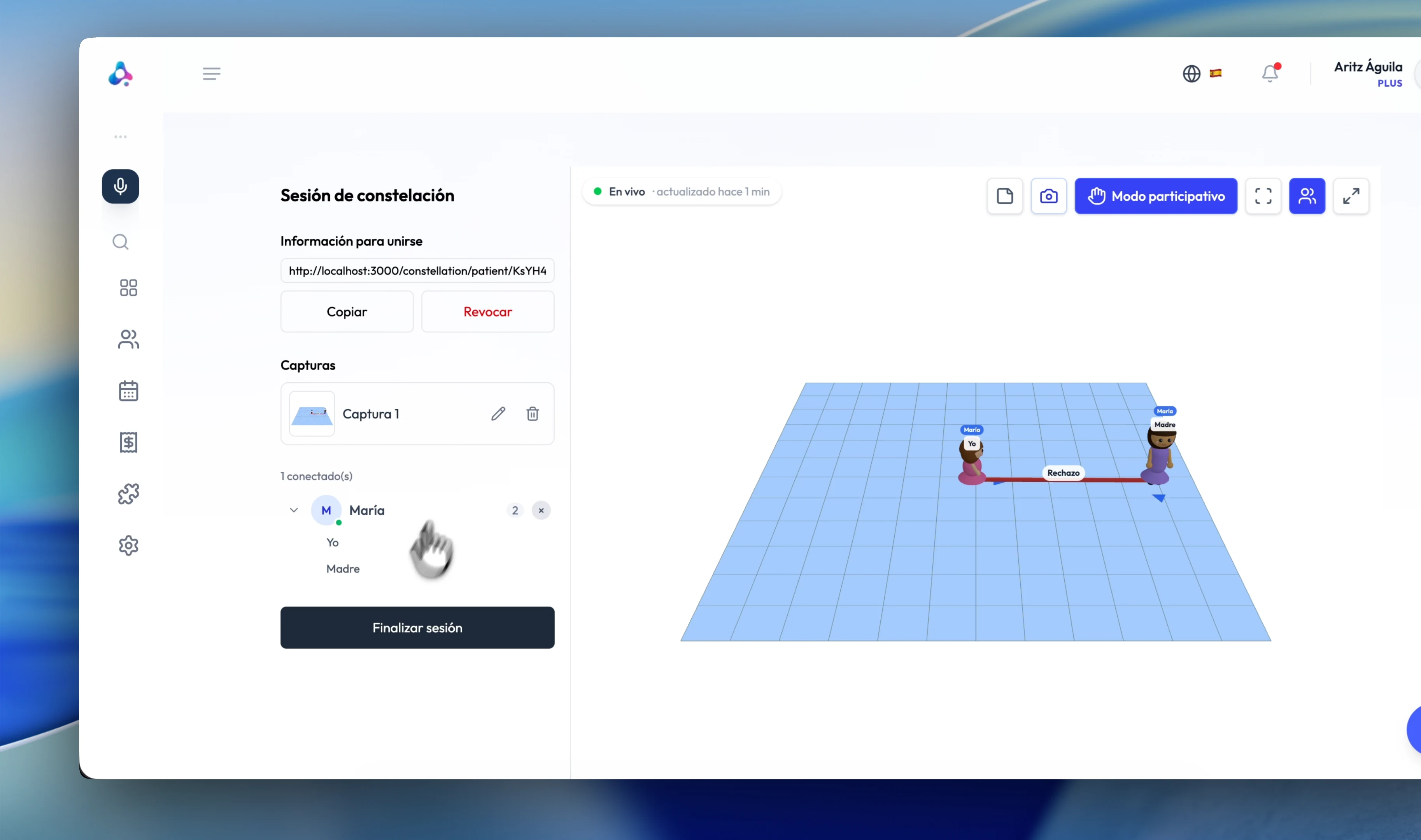
-
Genogram & Ecomap
The family's genogram and the ecomap of its systems, in standard notation and drawn four-handed. The patient joins with a link, and the map grows from one session to the next.
See Genogram & Ecomap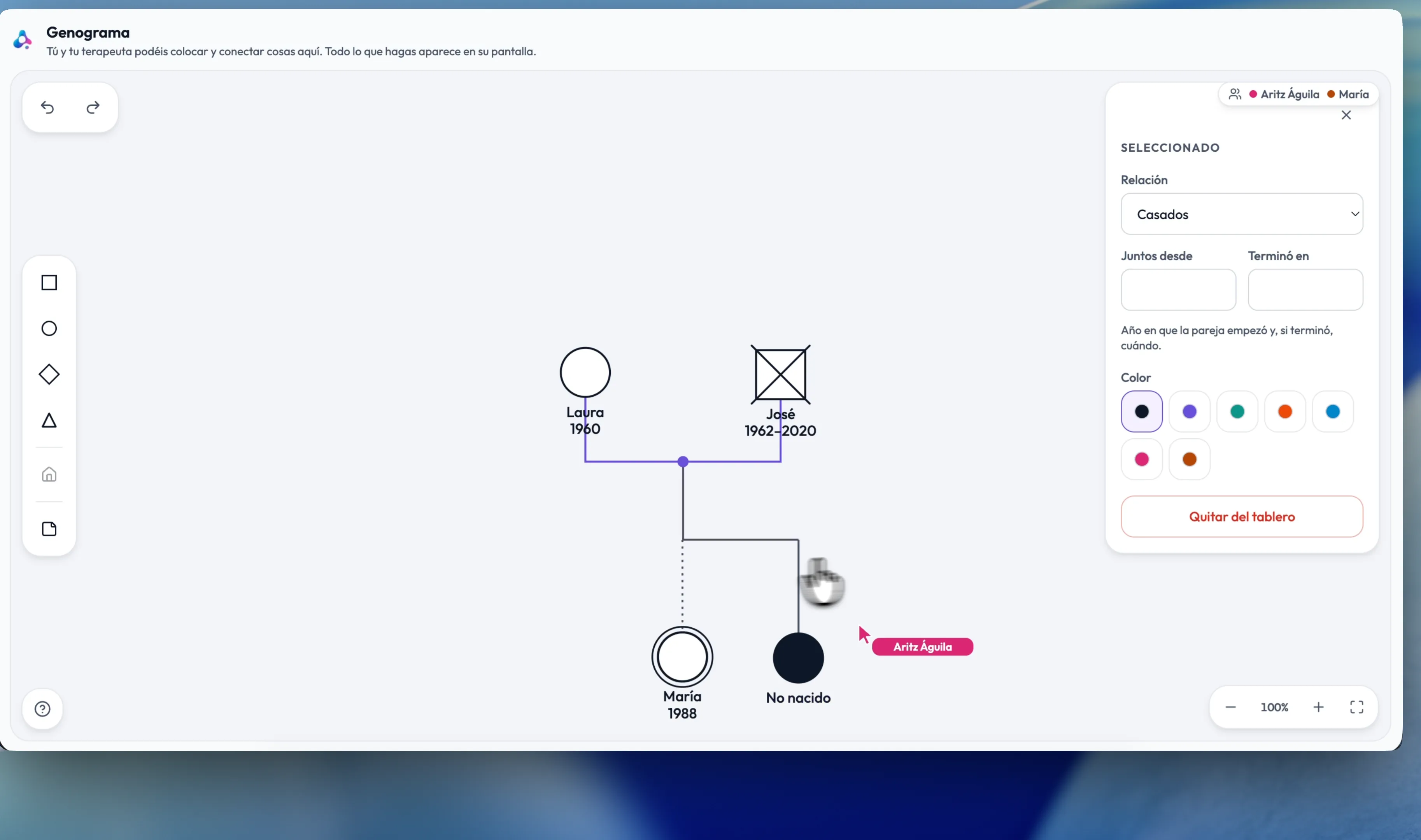
-
Meditation & Visualisation
Guided meditations and visualisations, written or recorded in your own voice. In session they play once for both of you, with the script scrolling on your screen as a teleprompter.
See Meditation & Visualisation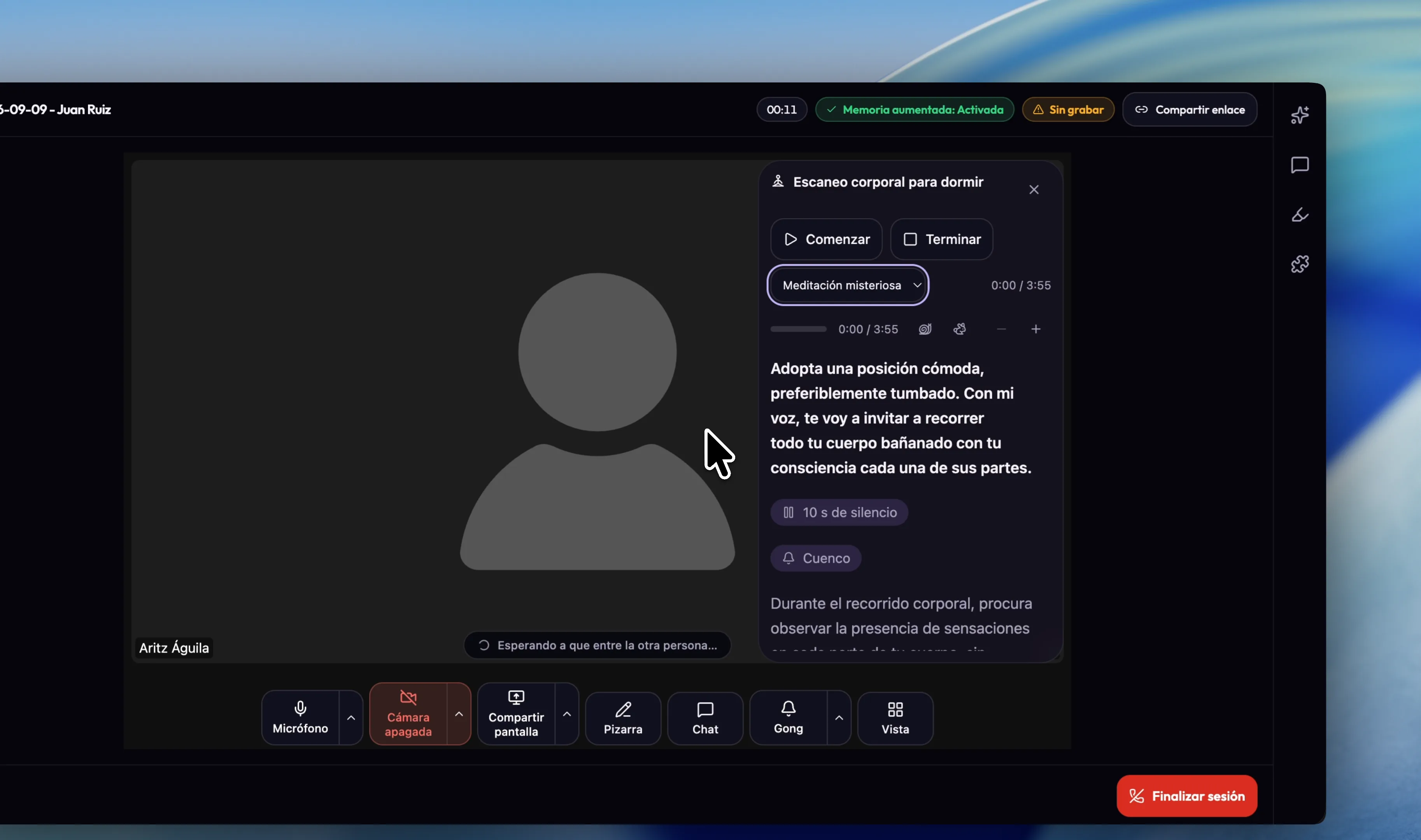
-
EMDR Beta
Bilateral stimulation drawn on the patient's own screen — visual, auditory or through their controllers — in a call or in the consulting room. The SUD and VOC of every set stay in the session.
See EMDR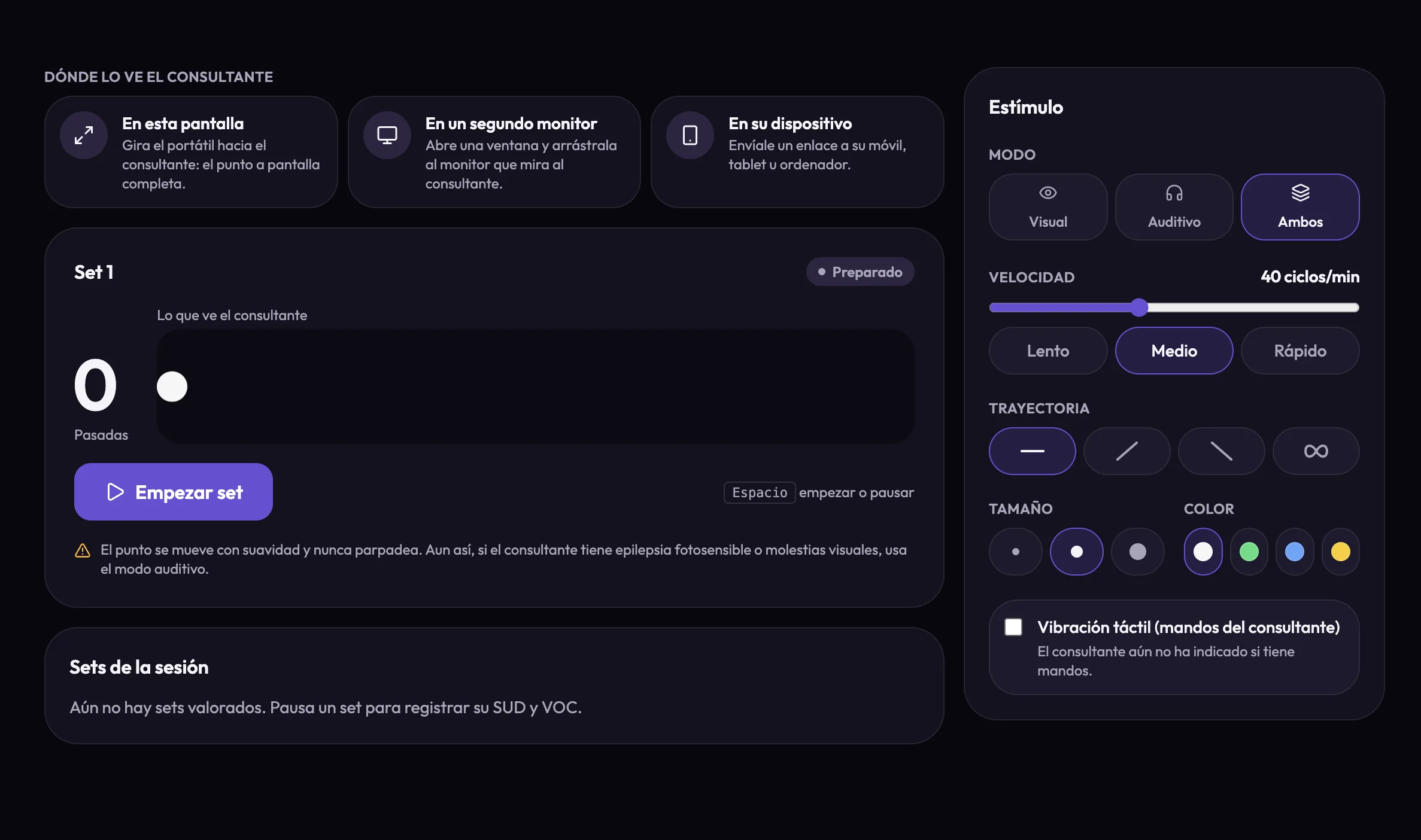
IFS
Parts work (Internal Family Systems) following the model's own rhythm, not a generic template.
And your method?
The catalogue grows with what people ask us for. If the way you work needs something that is not here yet, we want to hear it.
Tell usNone of them is mandatory: you adopt the one you use and remove it whenever you like. The method, the judgement and the relationship stay yours — Alchely only makes sure the screen does not get in the way.
Discover all the toolsA platform that grows with your practice
Every therapist works differently. Alchely isn't here to change how you work: it's the base you build your online practice on, and you switch on only what you need. These four are the ones that run the practice day to day; the ones that hold up how you work have a section of their own.
Augmented Memory
The notes write themselves, and from there come the analysis of every session, the alerts, the recommendations and a chat about the history.
See the tool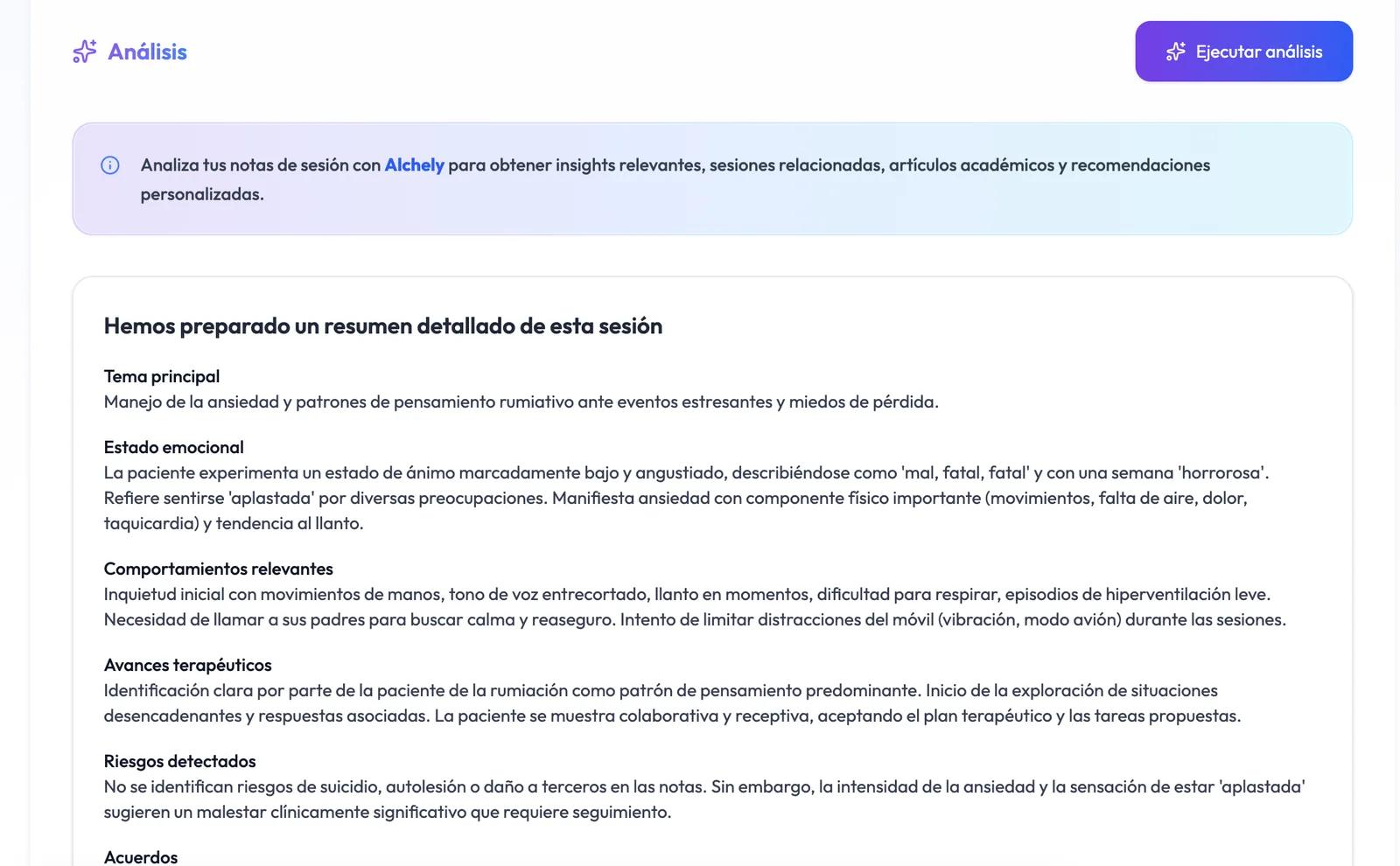
Scheduler
Your availability published, sessions with an automatic link and a synced calendar. Your patient books from their portal and gets the notices by email or WhatsApp.
See the tool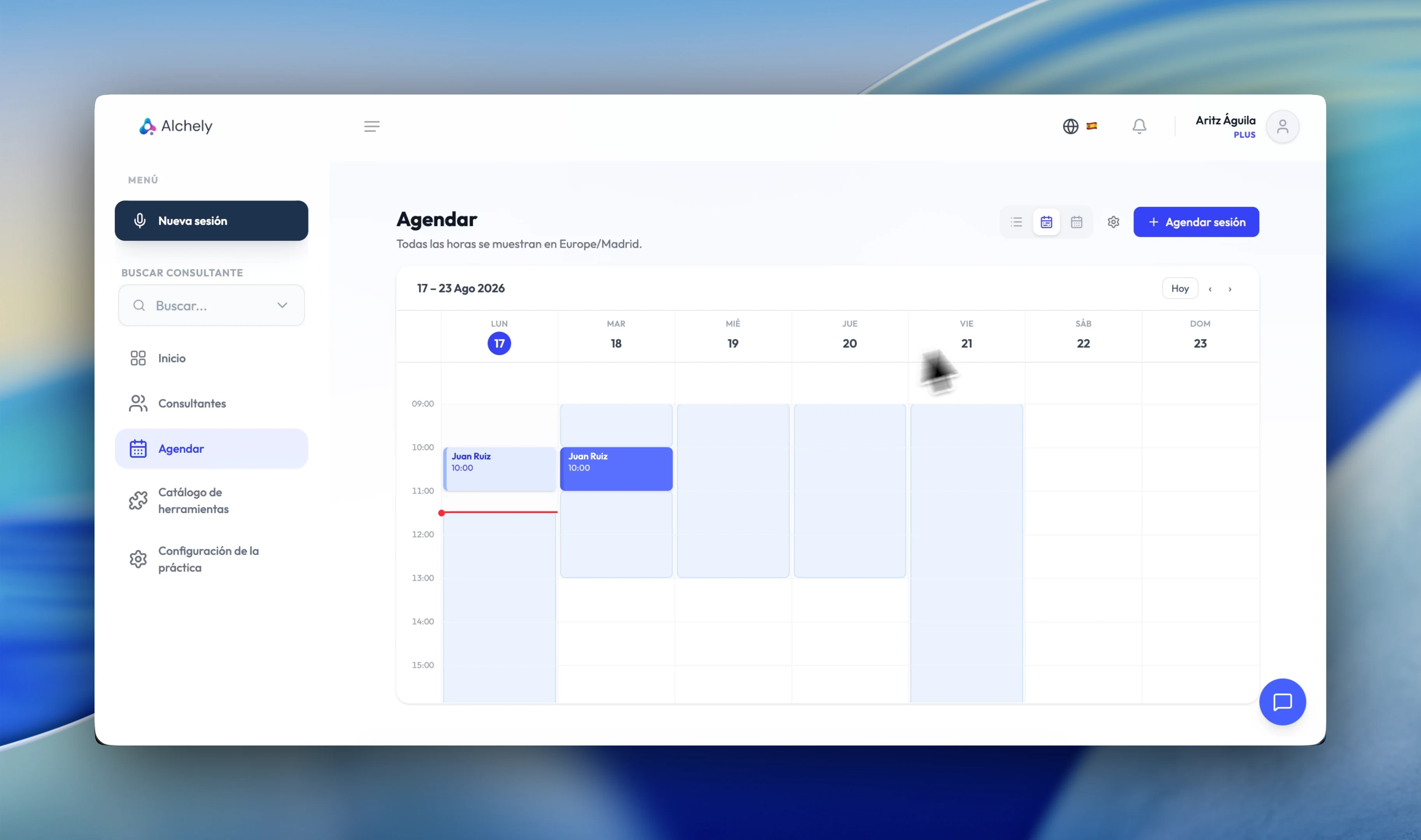
AlchelyMeeting
The video call inside Alchely: your patient joins with nothing to install and no account, and you have their history beside you.
See the tool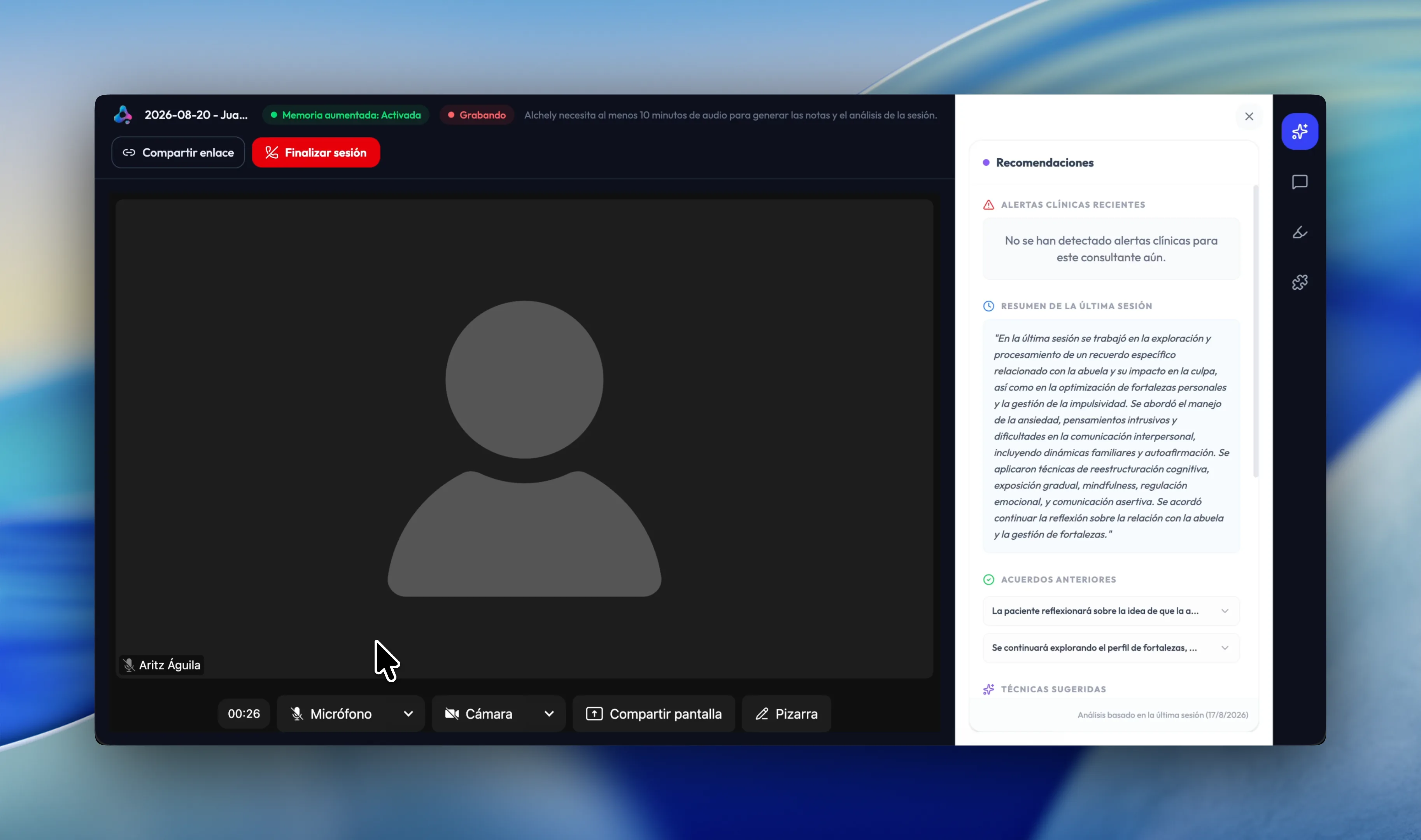
Payments
You record the charge from the session and Alchely chases it for you, by email or WhatsApp. Online payment through your own Stripe account.
See the tool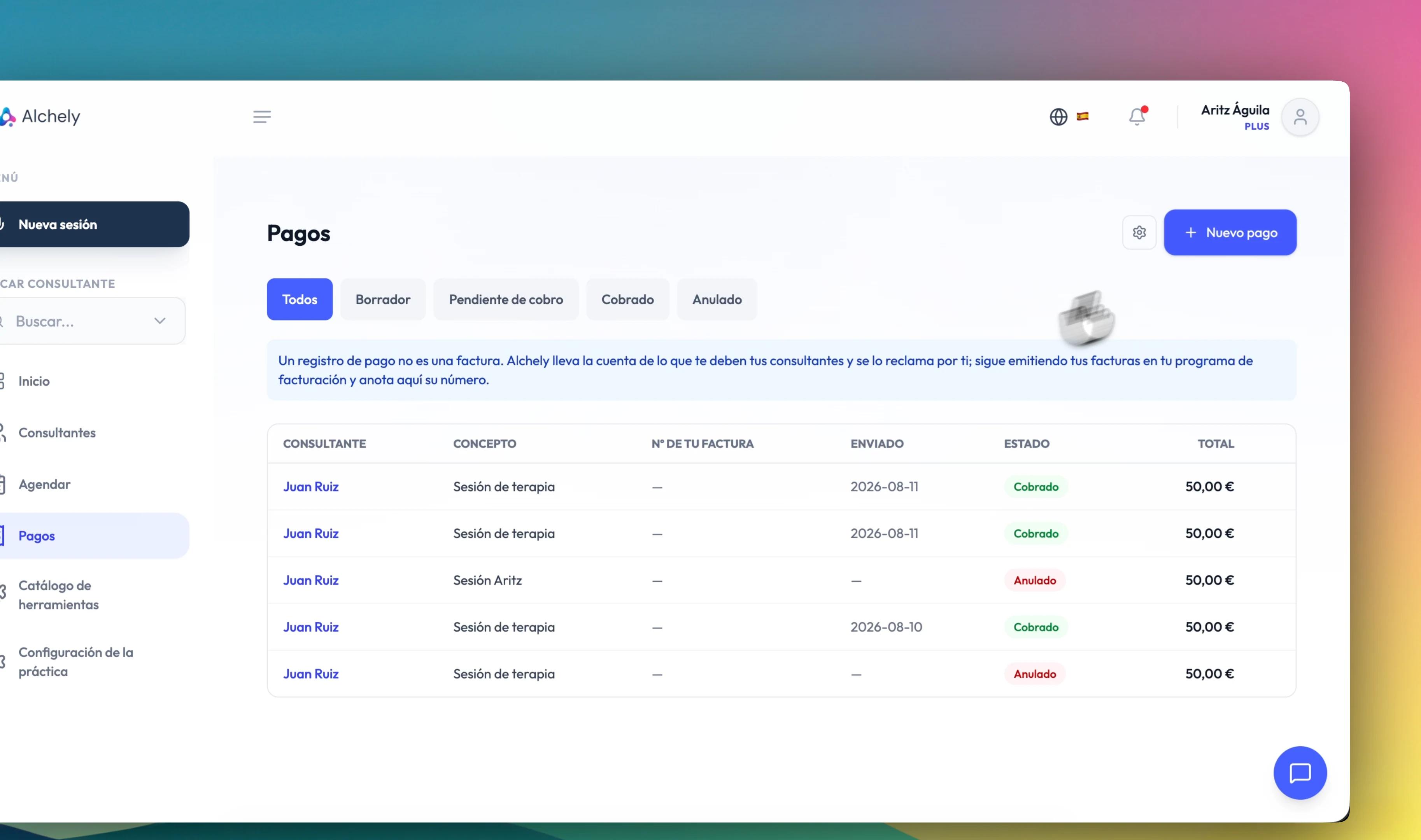
Don't pay for what you don't need
See the plansAlchely's free plan is a plan, not a fourteen-day trial: written, dictated or photographed notes, templates, the patient portal and reports on your work, at no cost and with no expiry date. You only move to Plus the day a particular tool genuinely becomes necessary.
And even then you do not carry everything: the dashboard does not arrive full of features you will never open. You add only the tool you use and drop it the moment it stops helping — no migration, and nothing you already produced with it is lost. Tools that carry their own price are adopted one at a time, never as a bundle.
It works with what you already use
You don't have to change your video calls, your calendar or the way you get paid. Alchely connects to the tools you already have — official connections that you switch on, and disconnect whenever you want.
-
Zoom
The session link is created when you book it, and with Zoom connected its summary or transcript lands in the patient's record on its own.
-
Google Meet
Every online session comes with its Meet link generated automatically. Nothing to copy, paste or send by hand.
-
Google Calendar
Your sessions show up in the calendar you already live in, and changes sync on their own. Prefer not to connect it? An .ics invitation goes out by email.
-
Microsoft Teams Beta
With your Microsoft 365 work account, the Teams meeting is created in your Outlook calendar when you book, and its transcript can come in on its own as the session draft.
-
Stripe
Online payments through your own Stripe account: the money goes straight to you, with no Alchely commission and no bank details passing through us.
-
WhatsApp
Session and payment notices on WhatsApp too, for patients who accept it in their portal; everyone else gets the email. Nothing to connect: it comes from Alchely's number.
- Official OAuth connection: your password never passes through Alchely
- Connect only what you use, and disconnect it in one click
- Don't want to connect anything? AlchelyMeeting brings the video call inside
A whole centre, with every patient in their place
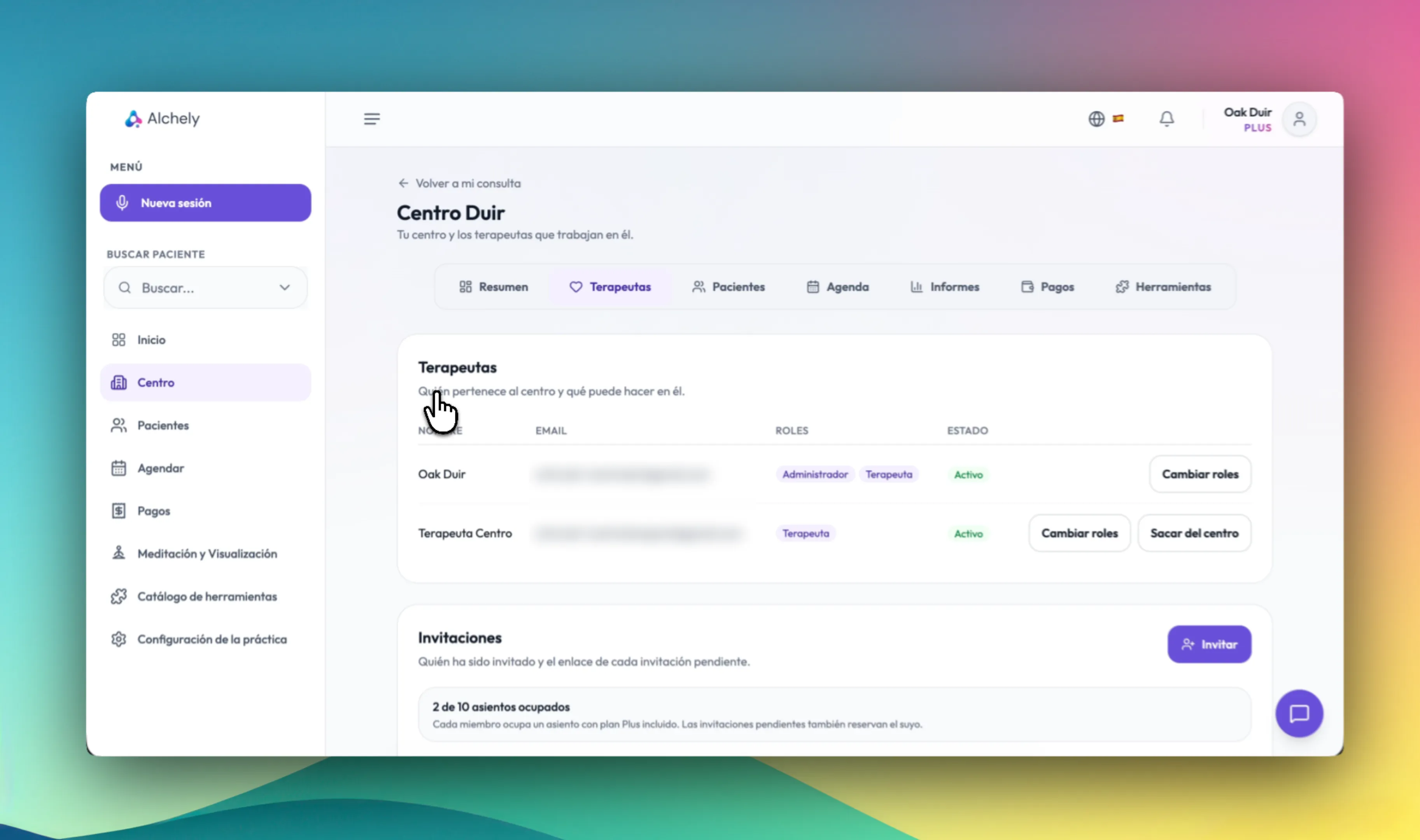
If there are several of you, Alchely is for you too. A therapy or training centre has its own account: the administration invites the team, shares out and hands over patients, covers absences in the agenda, reads each therapist's report with per-session rates if it sets them, and charges through the centre's own Stripe account. Every therapist stays in their own dashboard, and the administration never sees anything clinical.
-
A team with seats
Invitations bound to one email address, and every seat with the Plus plan included.
-
The centre's patients, or their own
Each therapist chooses; their own patients stay out of the centre's sight.
-
The centre's agenda, reports and payments
No session links, no titles, no payment concepts: just what running it needs.
-
Training centres too
Trainers, students, courses and academic year.
Secure and private – as it should be
Your data is protected following the general data protection regulation (GDPR). We are built with privacy at the core, ensuring that you and your clients remain protected at all times.
GDPR
Fully compliant standards.
Never used for training
Your sessions never train our models, and we sell nothing to third parties.
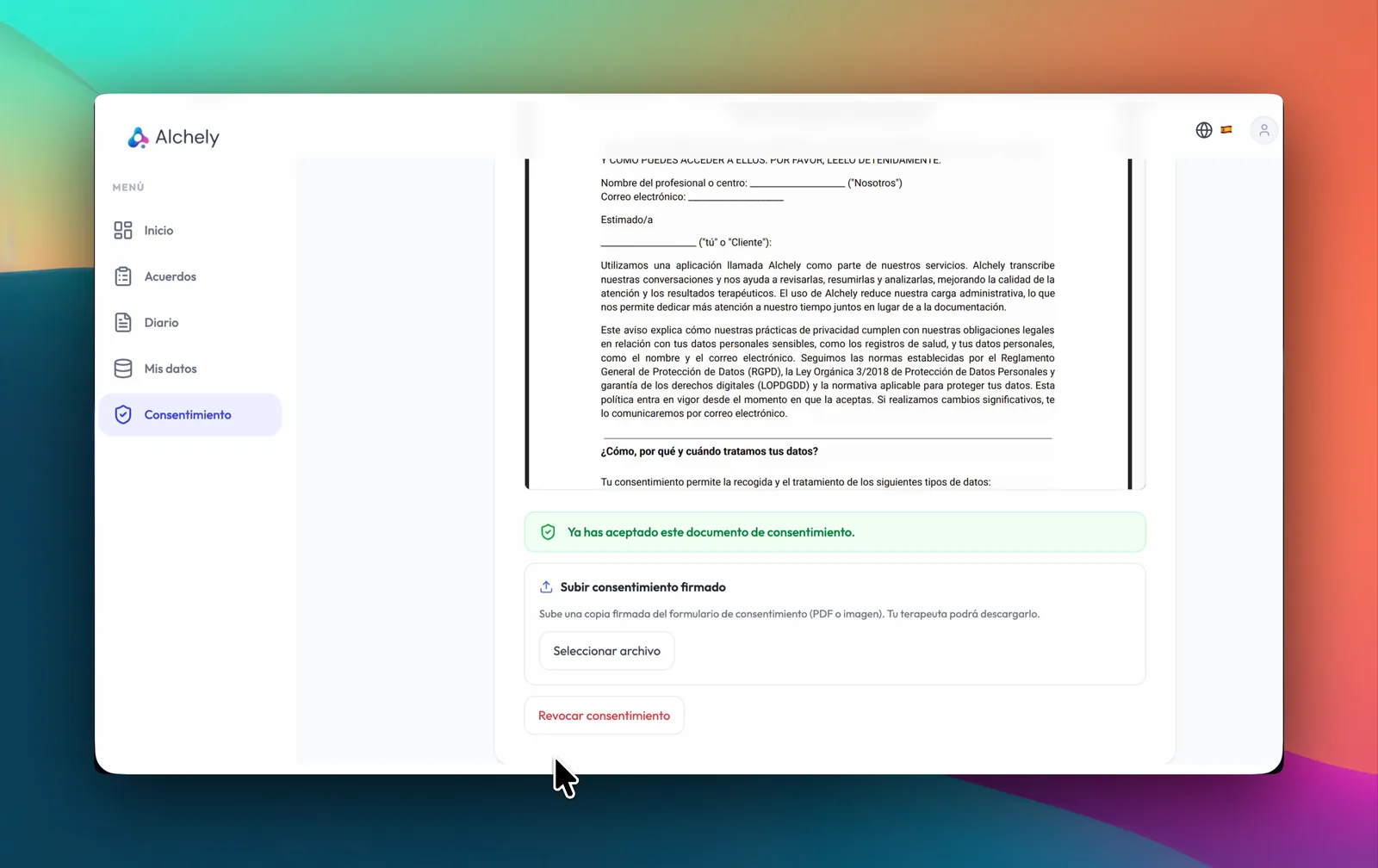
- Encrypted at rest and in transit
- GDPR compliant
- Two-factor authentication (MFA)
- Your sessions never train our models
The latest thing we wrote
We write about the part of the profession that does not fit in a textbook, with the references in front of us.
AI is already in the consulting room: what the APA says about how it should be used
The APA puts artificial intelligence among its nine trends for 2026, in two opposite versions: the one that supports the clinician and the one that replaces them. What it backs, what it warns about, and what the AI Act still requires after July's postponement.
Read the articleFrequently asked questions
The things people ask us most before starting.
Do you use my sessions to train your AI?
No. Alchely never uses your sessions or your patients' data to train AI models. We do not sell information to third parties or data brokers either.
Does my patient have to give consent?
Yes, and they give it themselves — you cannot give it for them. AI-usage consent is built into the portal's agreements flow: without it nothing is analysed, and an AlchelyMeeting session does not record.
Do I have to use every tool?
No. The dashboard works on its own, and each tool is adopted and removed from the catalogue whenever you like. Writing or dictating your notes, uploading audio or a photo of your notes always works, with or without a tool.
Does Alchely issue invoices?
No, and that is deliberate. Payments tracks what you are owed — who owes what, reminders, a payment link — but issues no fiscal documents. You keep invoicing in your usual software and note the reference here. The Payments page explains it in full.
Does it work for couples and group therapy?
Yes. As well as individual patients, you create couples and groups of three to twenty of your patients, each with their own sessions, bookings and tools. In a group, every member gets the invitation and the session link in their own email, without learning who else attends. AI processes a couple or group session only once every member has given consent.
Does it work for a centre with several therapists?
Yes. A therapy or training centre has its own account, with an administration that shares out patients, runs the agenda, the reports —each therapist's included, with their rates— and payments, and decides which tools the team uses, without ever seeing anything clinical. Every seat includes the Plus plan. The whole story is on Alchely for centres.
Can I get a summary of the month's sessions?
Yes, on any plan. In Reports you see your sessions held, pending and cancelled, by type and by patient, and you download the statement for a month or a year as a PDF or an Excel file. If you set your per-session rates, it adds up the amount too. It is an informative document, not an invoice. In a centre, each therapist sees their own and the administration sees the whole team's.
Do I need Zoom, Google Meet or Teams?
No. You can connect them if you already use them —Microsoft Teams, in beta for now—, hold the session inside Alchely with AlchelyMeeting, or use no video at all and work from notes.
If I drop a tool, do I lose what it already produced?
No. Analyses and alerts already generated stay readable even if you later remove the tool.
Where is the data hosted?
On cloud infrastructure with multi-region redundancy, continuous monitoring and a full audit log, encrypted at rest and in transit.
Can I try it before deciding?
Yes. You can create a free account and set your practice up with no commitment. If you would rather we showed you, get in touch and we will walk through it together.
Set your practice up today, for free
Session notes, templates and the patient portal are the free plan — not a fourteen-day trial. You add a tool the day your way of working genuinely needs one, and drop it the day it stops helping.
No card required · Nothing turns itself on · The free plan has no expiry date
Would you rather we showed you? Walk through it with us →
Open beta, limited places: the first year is free, paid tools included. Claim an early-adopter place →