Marketplace tool

Genogram and ecomap, online

The two instruments systemic work runs on, on a board the two of you draw. The genogram holds the family generation by generation; the ecomap places the person among the systems they deal with today. And the map stays with the patient, to pick up again next session.

Why draw it with the patient watching?

A genogram on paper gets drawn once, filed in a folder, and the patient never sees it again. But the instrument is not the drawing — it is what happens while it is being drawn. Who gets left out without meaning to, which surname turns up twice, which generation repeats the same cutoff.

A shared board gives that conversation back, and adds what paper cannot: the map persists and grows. The next session does not start by redrawing the family from memory — it starts where you left it, with the aunt who surfaced halfway through last time already in place.

The tool in motion

A genogram, being drawn

How a person is placed, how the tie between two of them is drawn, and where the children hang from — with the patient on the other side doing the same, on the same board.

A genogram in Alchely, from the patient's side.
Inside the board

Two instruments, one board

The notation is not ours: a genogram drawn with invented symbols cannot be read by the next clinician. The genogram follows McGoldrick, Gerson and Petry; the ecomap follows Hartman. What Alchely adds is that both get drawn four-handed, and are kept where the rest of the patient's history lives.

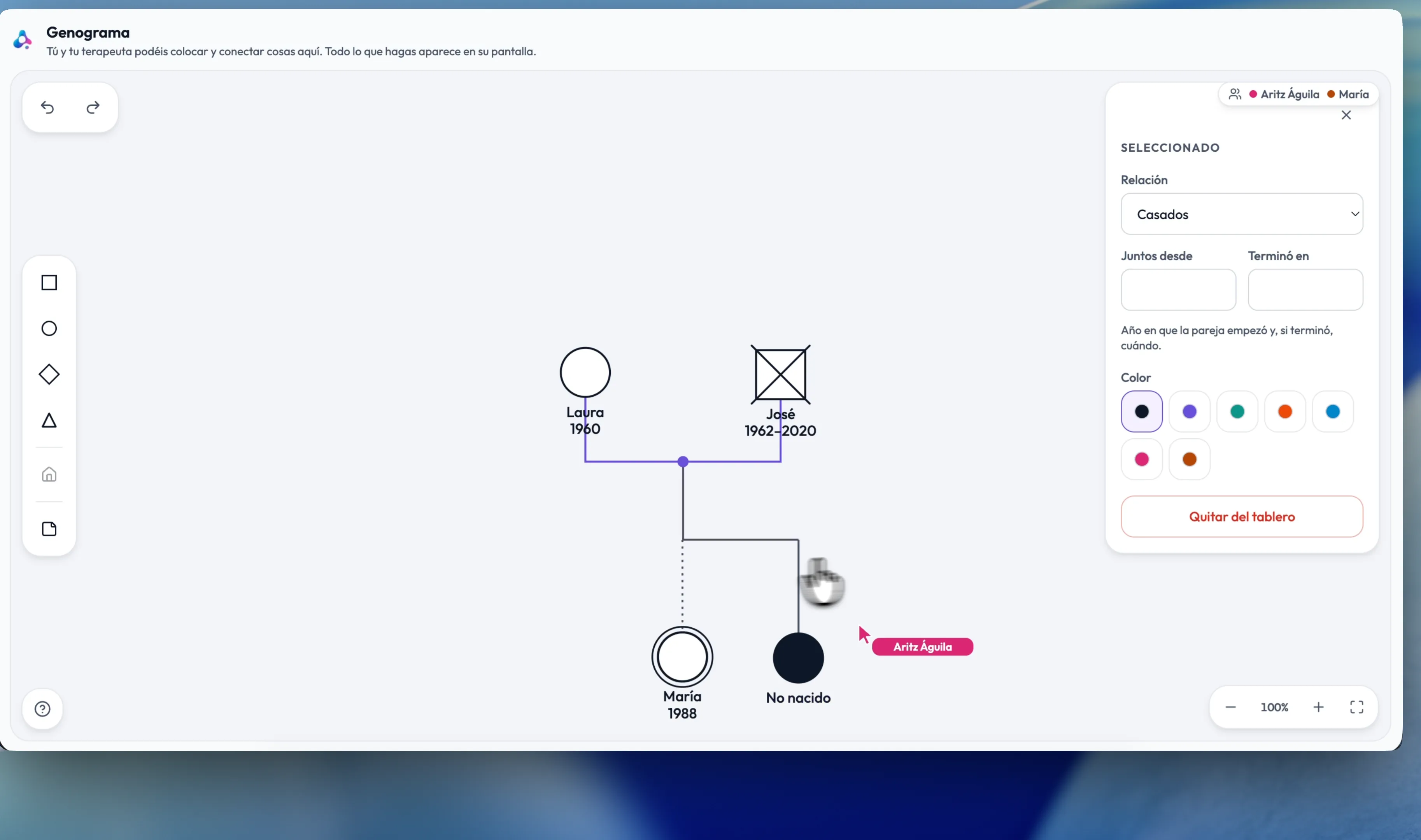
A genogram board in Alchely: the couple joined by their line, one of them carrying the cross for the deceased, and two filiations hanging off it, one of them a pregnancy loss
The genogram

Three generations, in the notation you already use

Each person with their symbol — square, circle, diamond when it is unknown, triangle for a pregnancy — their name, their birth and death years, the cross for whoever is gone and the double outline for the index patient. Couples are joined by their line, carrying the kind of union — married, cohabiting, engaged, separated, divorced, annulled — and the years it started and ended.

Children hang off the couple's line, as the notation requires, and each carries its filiation: biological, adopted, fostered, step, twin or identical twin, and the pregnancy losses that so often explain a whole generation. A household is drawn around whoever lives together, with its own name.
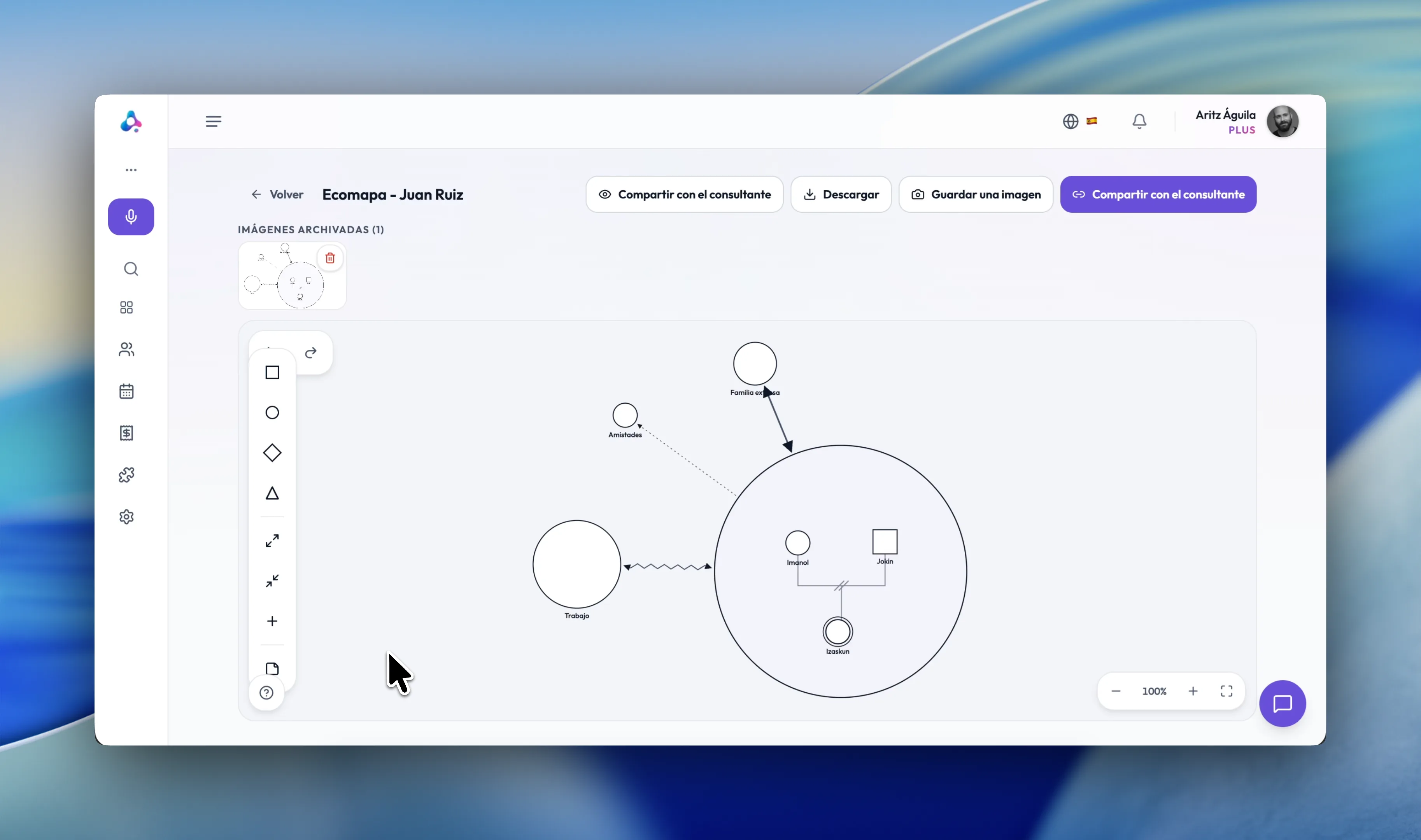
An ecomap in Alchely: the household inside the central circle, holding the couple and their daughter, and the systems around it — extended family, friends, work — joined by ties of different strengths, with the energy direction in the arrowhead
The ecomap

The person at the centre, and everything pulling at them

The central circle holds the household — not a lone figure: the circle grows with the family inside it — and around it you place the systems: extended family, work, school, friends, health, spirituality, leisure, community, social services, finances, and whatever fits no category. Each is drawn at the size it deserves, because size is meaning here: the family that fills someone's life is not the same size as their Tuesday shift.

Every tie to a system carries two things at once, which is what separates an ecomap from any other diagram: how strong it is — strong, tenuous or stressful — and which way the energy runs: towards the person, from the person, or both.

The emotional layer

What turns a family tree into a clinical instrument

A tree says who descends from whom. A genogram says how they get on. Between any two people you draw the tie and name it: close, fused, distant, hostile, cutoff, broken — and the compound forms clinical work meets daily, fused and hostile, close and hostile — plus neglect and abuse.

Every element can carry your own colour, picked from a closed palette that reads the same in light and dark themes and with colour-vision deficiency. It marks a branch, a pattern that repeats, or one session's work, without the board becoming unreadable.

Four-handed

Your patient holds exactly the same tools you do

You send a link and they are in: no account, nothing to install, only the name they want to appear under. From there they place people, draw relationships and move whatever needs moving, and it all shows up on your screen as it happens. The symmetry is deliberate: a patient who places their father themselves is not telling you the same thing as one who says where to put him.

Notes left on the board are signed by whoever wrote them, and every element remembers who last touched it. There is undo and redo, a drawn legend you can show or hide, and a map can belong to one patient, to a couple, or be an open board several people join through the same link.

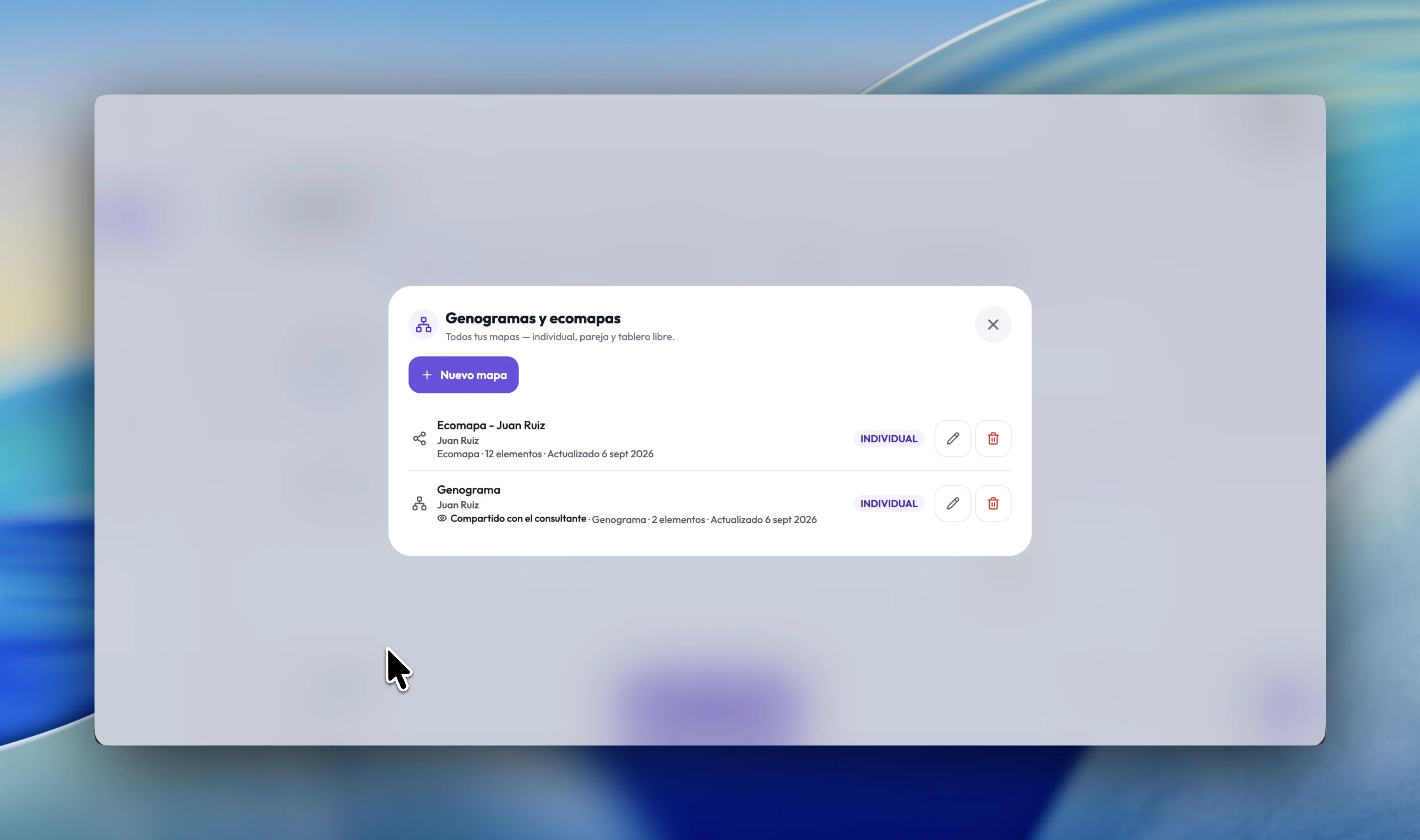
A therapist's Genograms-and-ecomaps list: an ecomap and a genogram about the same patient, each row carrying its instrument, element count and date, with one of them marked as shared with the patient
What stays

The map lives in the record, not in your downloads folder

Save an image of the board whenever you want and it is filed alongside the map, ready to download for a report or for supervision. Open the map to the patient's portal and they can read it as often as they like, and unsharing is one click. It opens from the tool dock: on your home screen, on the patient's page, or from the session itself. There is no map per appointment — it is always the patient's, the same one as last time.

Your maps are listed together, filtered by instrument, by patient and by date, so finding the ecomap from four months ago does not depend on remembering what you called it. And deleting a map deletes its images with it: a genogram holds three generations of people who are not your patients and who never consented to anything.

Why use it

What systemic work gains when the map is shared

On paper, the genogram ends up being the therapist's document about the patient's family. Shared, it is a document the two of them make — and that changes both what turns up on it and what can be done with it afterwards.

The patient sees their own map

It stops being a drawing the therapist makes and the patient never looks at. Seeing yourself inside the system, gaps and repetitions in plain view, usually does more work than any explanation.

The notation is the usual one

McGoldrick, Gerson and Petry for the genogram; Hartman for the ecomap. What you draw can be read by any colleague and any supervisor, and still means something outside Alchely.

It is not redrawn every time

The map grows across the process instead of being rebuilt from memory. The branch that appeared in session six is still there in session twenty, with the years and relationships that got clearer along the way.

Both instruments, without moving

The same family is read backwards with a genogram and outwards with an ecomap. Here you choose which as you create the map, and draw both with the same hands — no other app, no other file.

It stays as clinical history

Maps and their images live in the patient's record with the rest of their history. They are part of the data export and the erasure the GDPR requires you to be able to perform, with no loose folders to tidy.

One person, a couple, or a group

A map for one patient, one for the couple, or an open board several people join through the same link. Everyone with the same tools, and every piece knowing whose hand it came from.

Frequently asked questions

What is the difference between a genogram and an ecomap?

The genogram looks inward and backward: the family across three or more generations, with its unions, its children and the emotional quality of every relationship. The ecomap looks outward and at the present: the person at the centre and the systems they deal with today — work, school, health, friends, social services — each tie carrying its strength and the direction energy runs in. Two instruments from the same tradition, drawn here in the same place.

Which notation does it use?

The standard one, not an invention of ours. The genogram follows McGoldrick, Gerson and Petry: square for a man, circle for a woman, diamond when it is unknown, triangle for a pregnancy, the cross for the deceased and the double outline for the index patient, with the separation and divorce slashes on the couple's line. The ecomap follows Hartman. A genogram drawn with made-up symbols cannot be read by the next clinician, and that is what makes it useless as an instrument.

What does my patient need in order to draw with me?

A browser and the link you send them. No account, nothing to install, and the only thing they type is the name they want to appear under, which is what labels the pieces they place. The link lasts three days and you can revoke it whenever you like: it works for sending ahead of the session and for picking the board up in the next one, and it survives a dropped connection without locking the patient out.

Can the patient look at the map again after the session?

If you open it to their portal, yes, and read-only: they can look as often as they like and cannot move anything. Unsharing is one click, and the map stays in their portal only as long as you want it there.

Can I work with a couple, or with several people?

Yes. A map can belong to one patient, to a couple, or be an open board with no record behind it that several people join through the same link. Everyone holds the same tools — that symmetry is deliberate — and every element remembers who last touched it.

Can I take the map out of Alchely?

Yes. At any point you save an image of the board: it is filed alongside the map and downloads whenever you need it, for a report or for supervision. Deleting a map deletes its images too — a genogram holds three generations of people who are not your patients and never consented to anything.

Do I need a particular plan to use it?

Genogram & Ecomap is one of the Plus plan's tools, adopted from the catalogue whenever you want it and dropped the same way. What you already drew stays where it is: if you stop using the tool, a map you shared with a patient does not vanish from their portal.

It runs on the same platform as everything else

Add Genogram & Ecomap to your practice whenever you want — no separate account, no separate patient list.

Try it in your practice