What is the difference between a meditation and a visualisation here?
As a tool, none: both are a script you guide, a recording, or the two together. The distinction is one you make in the tags. The name mentions both because a good share of what gets written with this are visualisations — a safe place, resource installation in EMDR, a hypnotic induction — and somebody looking for that had no reason to open a card that only said “meditation”.
Do I have to record? Do I have to write?
Neither on its own, but at least one of them. A meditation can be a script alone — you read it live, with the background track playing underneath — a recording alone, or both: the same script there to read on the days there is a voice for it, and recorded for the days there is not.
Can I write the pauses into the script?
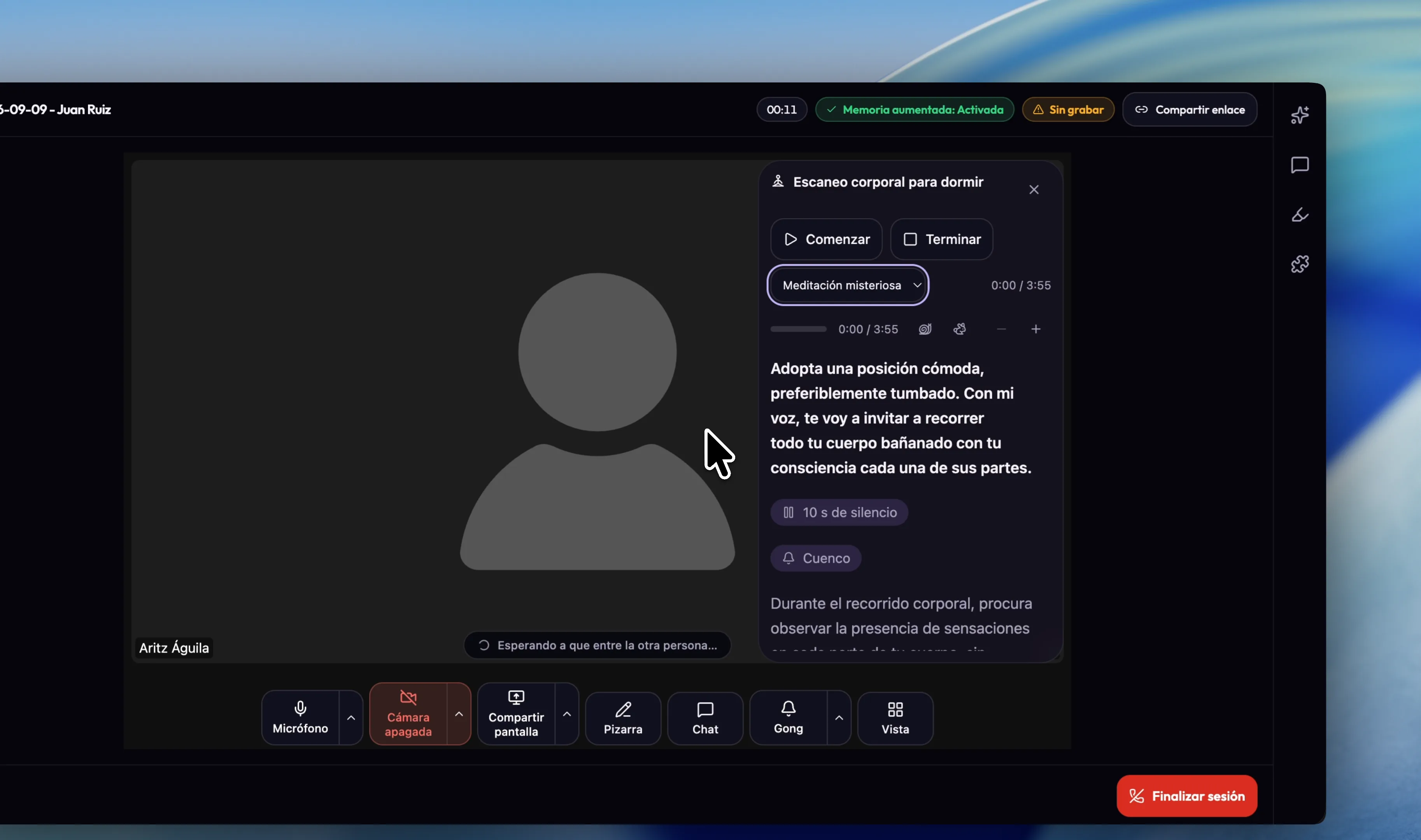
Yes, and it is how the prompter comes to respect them. [10s] is a ten-second silence and [2m] a two-minute one: the prompter sits on it, counting down, and the tag never reaches the screen. [gong] sounds the room's singing bowl for both of you, taking no time of its own. Those are the only two tags, and there will not be a third without a mechanism behind it: one the prompter did not act on would be a comment pretending to be an instruction. A written silence lasts what it says at any reading pace, and is capped at ten minutes so a typo cannot stall a session.
Can I trust the length shown in the catalogue?
The computed one counts exactly what the prompter then runs: the words at your pace, the breath between paragraphs, and any silences you wrote. What it cannot count is that with a patient in the room you slow down and the last silence runs, so you can write your own estimate in minutes. The card then shows yours first and the prompter's beside it.
What does my patient hear?
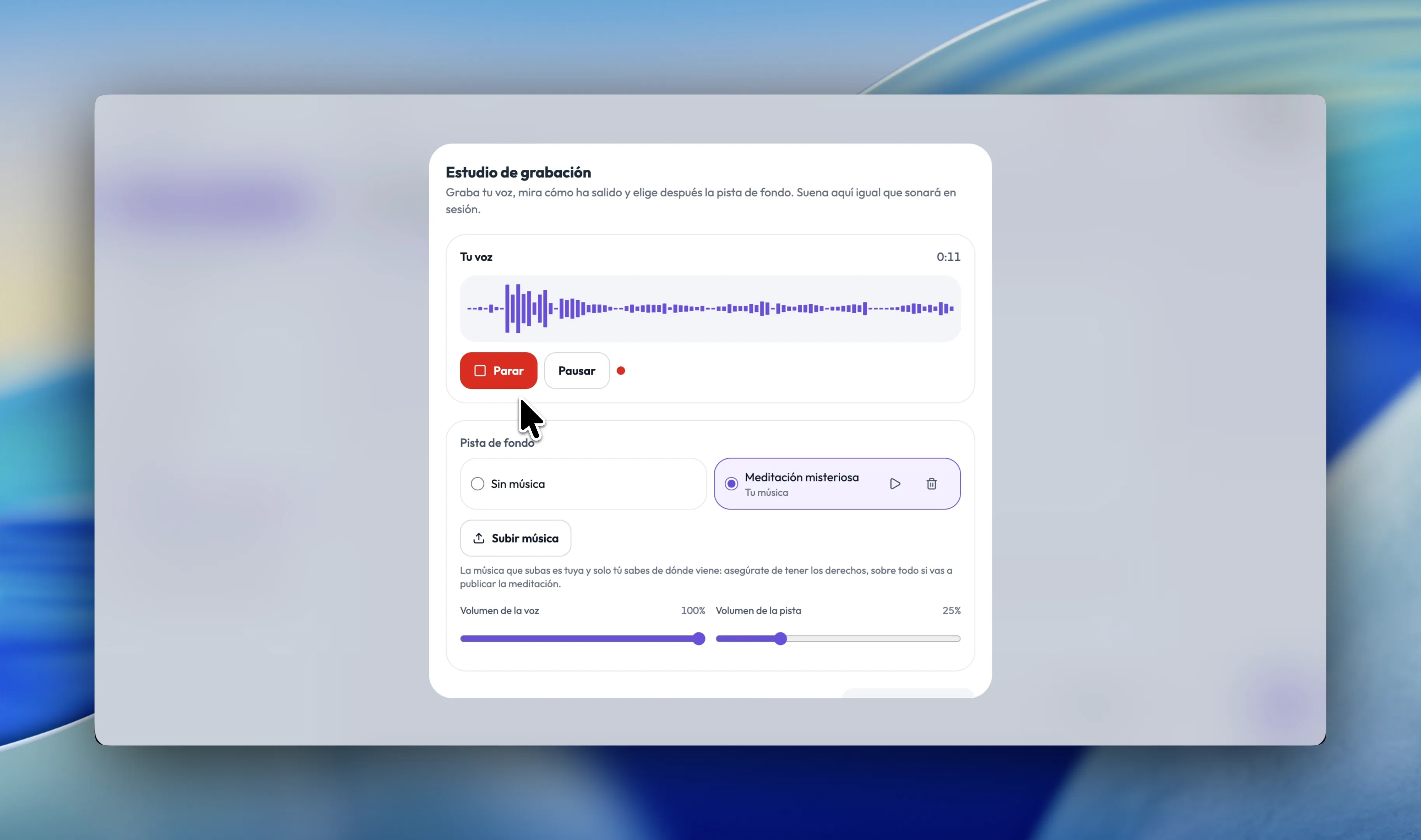
The same playback you do, from inside the call. The audio plays in your browser and is published into the room as one more track, so your patient is not running a second copy that drifts out of step with yours. When you end it, the track is withdrawn from the call. If the meditation is a script with a background track, what gets published is the track and your voice goes over it on your usual microphone.
Can my patient see the script?
No. Their screen only says a meditation has begun, with the title, and it takes itself away after ten seconds. There is no progress bar and no clock, deliberately: somebody with their eyes closed does not need to know how much is left. The controls are not theirs either: starting, pausing, seeking and ending are yours, and an instruction arriving from their side is ignored.
Can I use my own music?
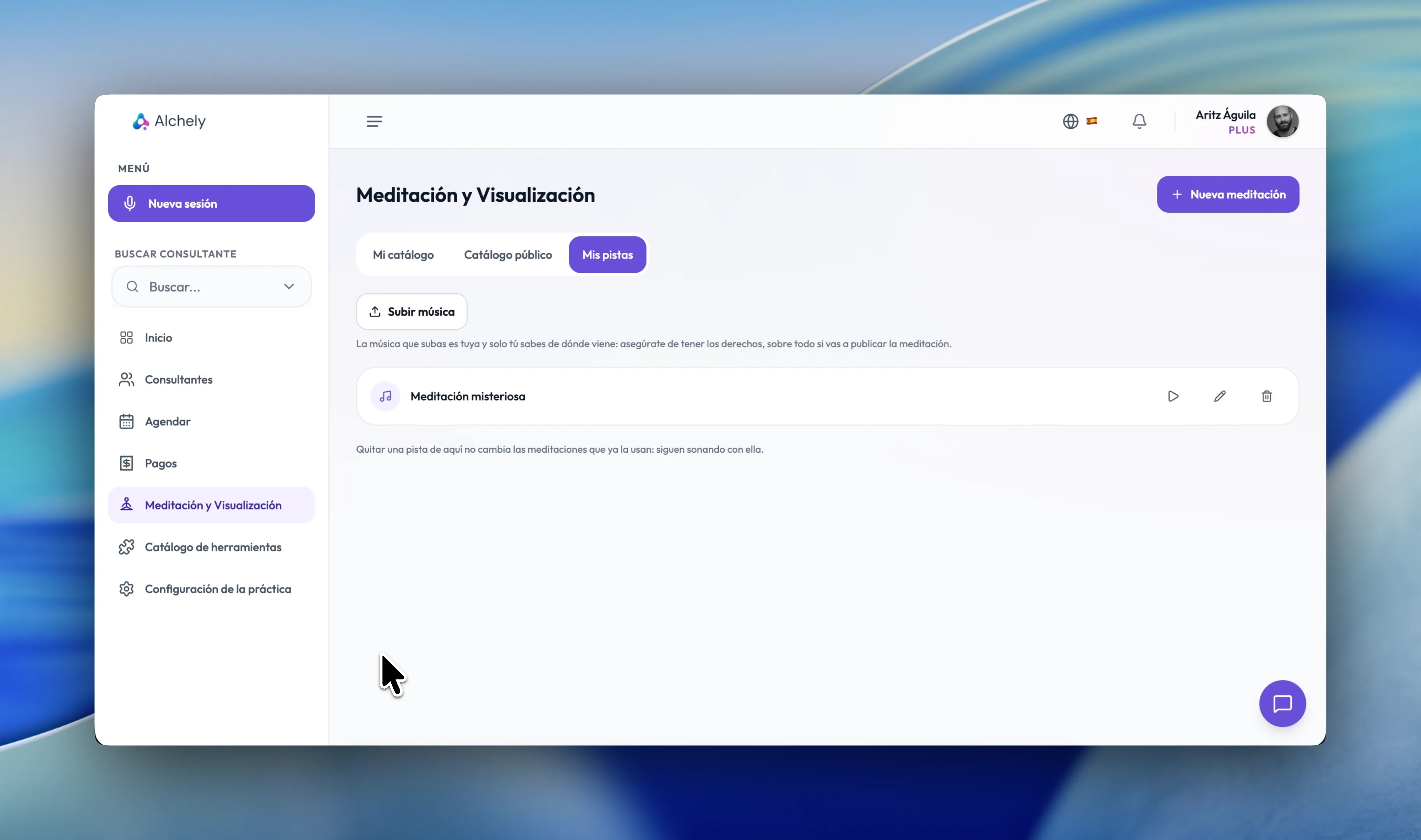
Yes. You upload it to your shelf, name it, and it is available in the studio and in the call, under as many meditations as you like. On upload you confirm you hold the rights to use it, including if you go on to publish the meditation — you are the only person who knows where that track came from. Removing it from the shelf does not change the meditations already using it.
Can I give it to a patient to practise at home?
Yes. You hand any of yours to any of your patients and it appears in their portal, to read or to play, with your voice and the bed mixed the way you set them. It is read-only and it is not a copy: they read your meditation, so what you edit tonight is what they hear tomorrow, and taking it back from one does not take it from the rest. You can also hand it to a couple or a group in one go: each member gets it in their own portal. The script's tags are shown to them as what they mean — “30s of silence”, “The bell sounds” — rather than raw. If you stop using the tool you stop handing them out, and the ones already handed out go with it.
If I publish a meditation, do I lose it?
No. Publishing makes it visible to other therapists under your name and the licence you choose, and by default that licence reserves every right. Editing it, withdrawing it and deleting it stay with you and nobody else. Whoever adopts it takes a private copy of their own that still says you wrote it, and if you withdraw the original those copies do not vanish from anyone's practice.
Does it work in any browser?
Recording and guiding, yes: the recorder negotiates a format the browser can actually produce rather than assuming one. Dictation is the exception, because Chrome and Safari offer it and Firefox does not; where it is missing the button simply does not appear, and the script is typed as normal.
Do I need a particular plan to use it?
Meditation and Visualisation is one of the Plus plan's tools. You adopt it from the catalogue whenever you want and remove it the same way, and adopting it puts it in your sidebar and in the AlchelyMeeting bar. If you remove it, your meditations stay where they are.
![The editor for a new meditation in Alchely: the title, the instructions, the language, and the script field with its dictate button and a script opening on the [10s] and [gong] tags](../../../assets/meditacion-editor.webp)