The warmth of your centre, online too
Alchely for centres brings your whole team under one centre account. The administration invites the professionals, shares out the patients, covers an absence, sees how the centre is doing and charges its patients; every therapist keeps working in their own dashboard, with their own method and judgement. And the clinical side stays with whoever treats: the centre's administration never reads a note.
For now, centres sign up by invitation: we send you the link to register yours. Every seat on the team includes the Plus plan.
Three ways to be part of the centre
A centre is an organisation with several professionals, somebody who runs it — who does not necessarily treat anyone — and patients who belong to the centre, not to whoever happens to hold them this month. Alchely models it that way, without making you choose between running and practising.
Administration
Signs the centre up, invites the team, and runs its patients, agenda, reports, payments and tools. It need not treat anyone, and an account that only administers is never offered as a patient's therapist.
Therapists
Work in the dashboard they already know: their sessions, their notes, their therapy tools. When they add a patient they choose whether it is the centre's or their own, and they use the tools the centre has switched on.
Both at once
The ordinary case in a small centre: whoever runs it also treats. You get a Centre entry in the menu and a way back to your own practice on every administration screen. They are two places, not two modes: you always know which one you are in.
What the administration runs
What a practice manager does all day — sharing out the work, covering an hour, seeing how it is spread, chasing what is owed, deciding what the team works with — has its own screen. Each one shows what running the centre needs, and nothing more.
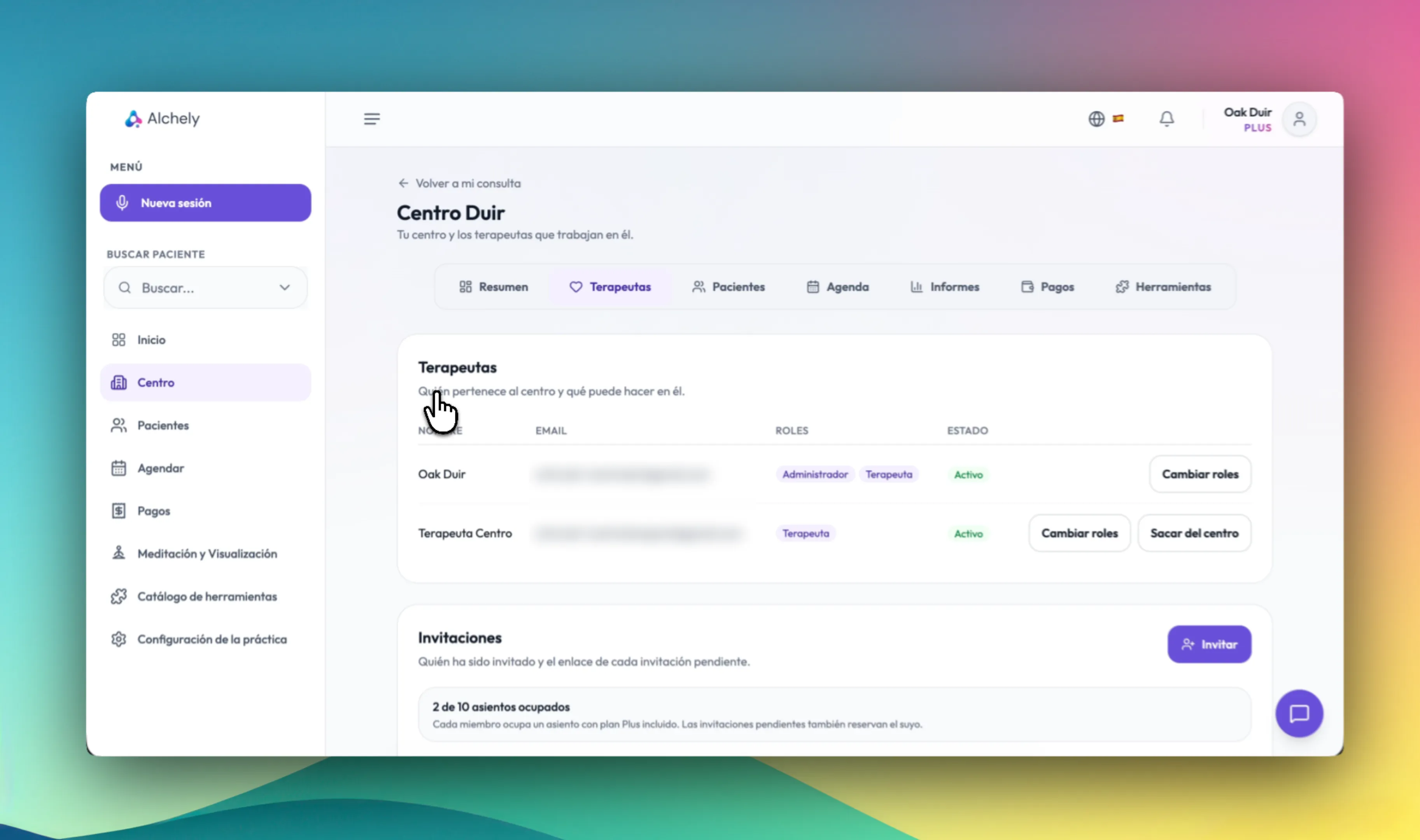
Team and invitations
You invite by email. Each invitation works only for that address, only once and for fourteen days, and it can be revoked; the link stays on screen in case the email goes astray. You change somebody's roles without inviting them again.
Seats with Plus
A centre starts with ten seats. Every member takes one — and so does every pending invitation, so the last seat is never promised twice — and every seat comes with the Plus plan. If you run short, it grows.
Patients and handovers
The centre's patients, with their therapist, their sessions and the date of the last one. Handing one over moves their sessions, appointments, therapeutic plan, constellations and genograms in one step, and couples and groups move as a whole. Payments stay with whoever raised them, and every handover is recorded with its reason.
Agenda and cover
Every booking in the centre, by date and by therapist, with no session link and no title. When somebody is off, you move that booking to someone else: the appointment moves, the patient stays put. An hour already taken is refused rather than double-booked.
Reports
Sessions, patients and payments by day, month or year, with the headline figures on top — active therapists, sessions, new patients, collected — and a filter by therapist. After a handover, each session still counts for whoever held it.
The centre's payments
The centre's patients are charged through the centre's own Stripe account, with its default amounts and its reminder setting. The administration sees amount, status and dates, never the concept line. Each therapist's own patients stay on their own account.
The centre's tools
The administration decides which tools the team works with: everyone in the centre has the ones switched on and none of the ones switched off. Switching one off deletes nothing, and switching it back on returns each therapist to where they left it.
Identity and libraries
The centre's logo goes on the emails its patients receive — bookings, payments, portal — and each professional's public profile names their centre. Constellation scenes, meditations and background tracks are shared in the centre's library.
What the administration does not see
A patient confides in their therapist, not in the company their therapist works for. So the centre's screens were built the other way round from usual: they do not hide the clinical side, they never receive it.
Nothing clinical, ever
No notes, no transcripts, no audio, no analysis, no alerts. What the administration sees of a patient is management data: who they are, who they are with and when their last session was. It is not a setting: there is no way to switch it on.
Only the centre's patients
A therapist in the centre can keep treating patients of their own, and those do not appear in the centre's agenda, reports or payments. Anyone who arrives with existing patients keeps them: they move into the centre one at a time, when their therapist records that the patient agrees.
One centre never sees another
Every centre is sealed off from the rest: asking for anything of another centre answers as if it did not exist, without even confirming that it does. An account belongs to one centre at most.
Trainers, students and courses
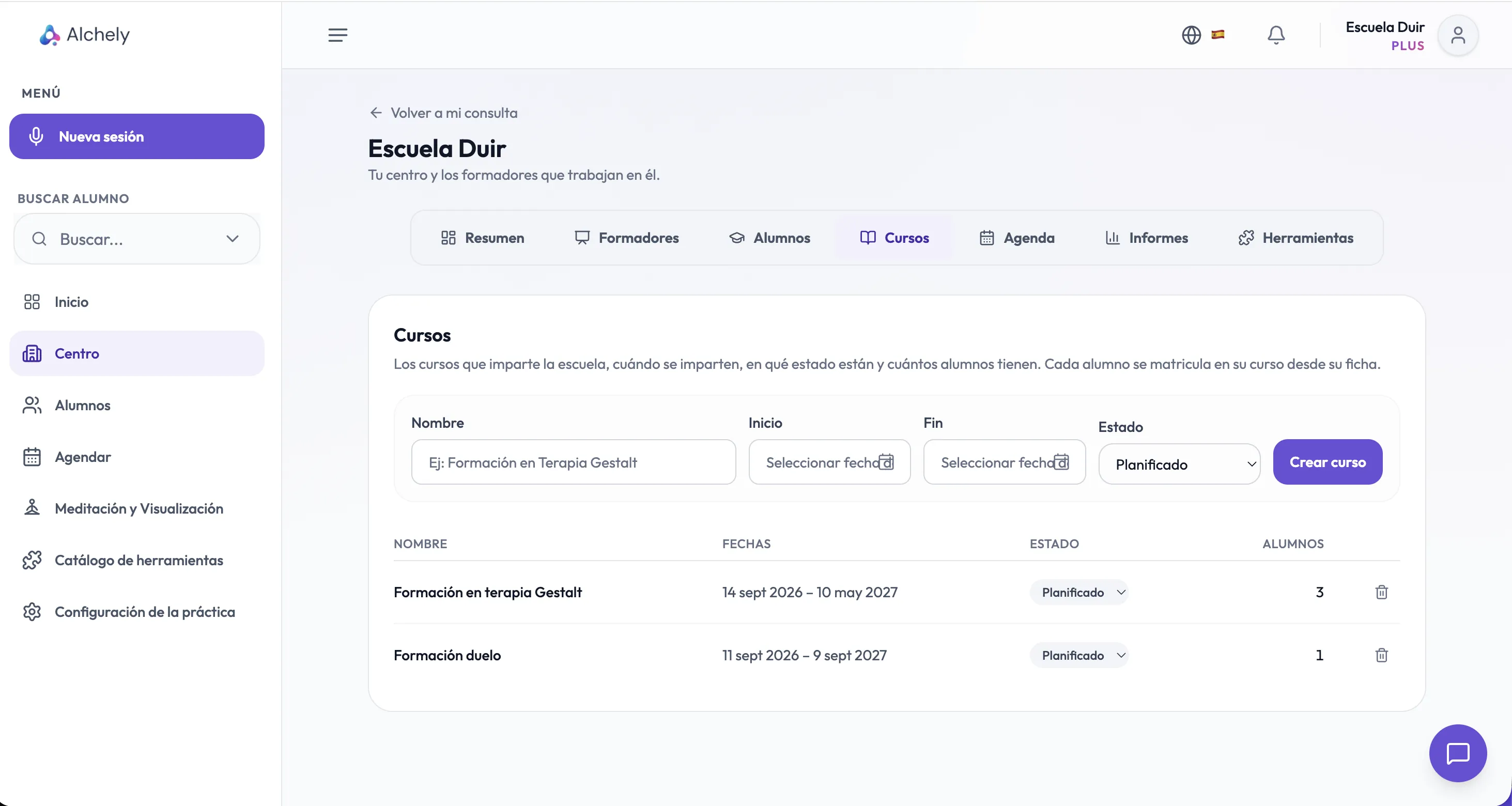
A centre is either a therapy centre or a training centre, and the type changes the words, not the way it works. In a training centre Alchely speaks of trainers and students on every screen — including for anyone who had picked another word in their own practice: if you teach, you have students.
The centre keeps its courses, and every student carries their course and academic year, both of which can be searched and filtered. Payments start switched off: they come on the day the centre needs them.
-
Courses
Name, dates, status and number of students. A course with students cannot be deleted by accident.
-
Academic year
Shown as 2025/26, and chosen from the current year and the ones after it.
-
Filters across the centre
Course and academic year can be searched in each trainer's student list and in the centre's.
How a centre gets going
The centre exists first and the people second, in that order. This is how it signs up, and how the team comes in.
Ask for the sign-up
Write to us. While centres sign up by invitation, we send you a link to register yours.
Create the centre
Its name, and whether it is a therapy or a training centre; the legal details can wait. Then your account, and one question: whether you also practise at the centre. That decides whether a patient can ever be assigned to you.
Invite the team
Anyone who already uses Alchely joins with their account; anyone who does not signs up from the link and lands straight inside the centre, without having to find the way in.
Choose the tools
You switch on the ones the centre uses. Every therapist who joins gets a welcome listing them, instead of a solo practice's setup.
The centre's patients, or their own
When adding a patient or a couple, the therapist chooses whether it is the centre's or theirs, and the lists say which. A group is the centre's when every one of its members is.
And if somebody leaves
Before they go, their centre patients are handed over to others on the team. Their own patients leave with them, and their account gets back the plan it had.
Frequently asked questions
What centres usually ask before they start.
What does Alchely cost for a centre?
Centres are part of the Plus plan: every seat on the team includes Plus for whoever holds it. A centre starts with ten seats and grows when it needs to. We agree the price with you: write to hello@alchely.com.
Can the centre's administration read session notes?
No, never. The administration sees management data — who the patient is, which therapist they are with, how many sessions they have had and when the last one was — and never notes, transcripts, audio, analysis or alerts. It is not a setting that can be switched on.
I already use Alchely on my own. Can I join a centre?
Yes, with the account you already have. Your patients stay yours: joining a centre hands nothing over, and the administration does not see them. A patient becomes the centre's only when you decide so, one at a time and with their consent recorded. While you are in the centre you are on Plus, and if you leave you get back the plan you had.
Do I have to see patients to run the centre?
No. When you create the centre you say whether you also practise. An account that only administers is never offered as a patient's therapist, nor in any list for assigning work.
What happens when a therapist leaves the centre?
Before they are removed, their centre patients are handed over to others on the team: individuals, couples and groups, the last two always as a whole. Their own patients stay with them, their account keeps existing, and it gets back the plan it had before taking the seat.
Can one account belong to two centres?
No. An account belongs to one centre at most, and an invitation from a second centre is refused without naming the first.
I work alone. Does anything change for me?
Nothing. If you belong to no centre, Alchely works exactly as it did: no centre menu, no question about whose patient somebody is, and no tool decided by anyone else.
Bring your centre to Alchely
Tell us how many of you there are, whether the centre is a therapy or a training centre, and how you work today. We reply with what the platform already does, and with the link to sign the centre up.
Working on your own? Start free as a therapist