Included in every plan

Therapeutic techniques

The techniques you work with, written once and to hand whenever you need them: with their steps, their indications and their cautions. Next to them, your centre's and the ones other therapists and Alchely publish. And with Augmented Memory, each session's analysis points to the one that fits.

Where do your techniques live today?

Spread across notebooks, training PDFs and folders on your computer. And many of them only in your head.

In Alchely each technique has its own record: goal, steps, when to use it and when not to. Yours, your centre's and the public catalogue's, one search away. And with Augmented Memory, after each session it suggests techniques from those same catalogues.

One record for each technique

Click Create technique and start with the basics: a title, one step and the format you use it in. You can add the rest later, whenever you need it. And don't worry: what you save stays yours alone until you decide to share it.

  • A summary and a goal: what it is and what it aims to achieve
  • Up to 30 steps, which you move up, move down and remove
  • Indications and contraindications: when it is indicated, and when not to use it or with what caution
  • Estimated duration and format: individual, couple or group
  • Therapeutic approach and presenting-problem tags; if yours is not on the list, you type it
  • The materials to prepare, and the references: authors, books or articles
Try it now
Inside the tool

Three catalogues and one way to search

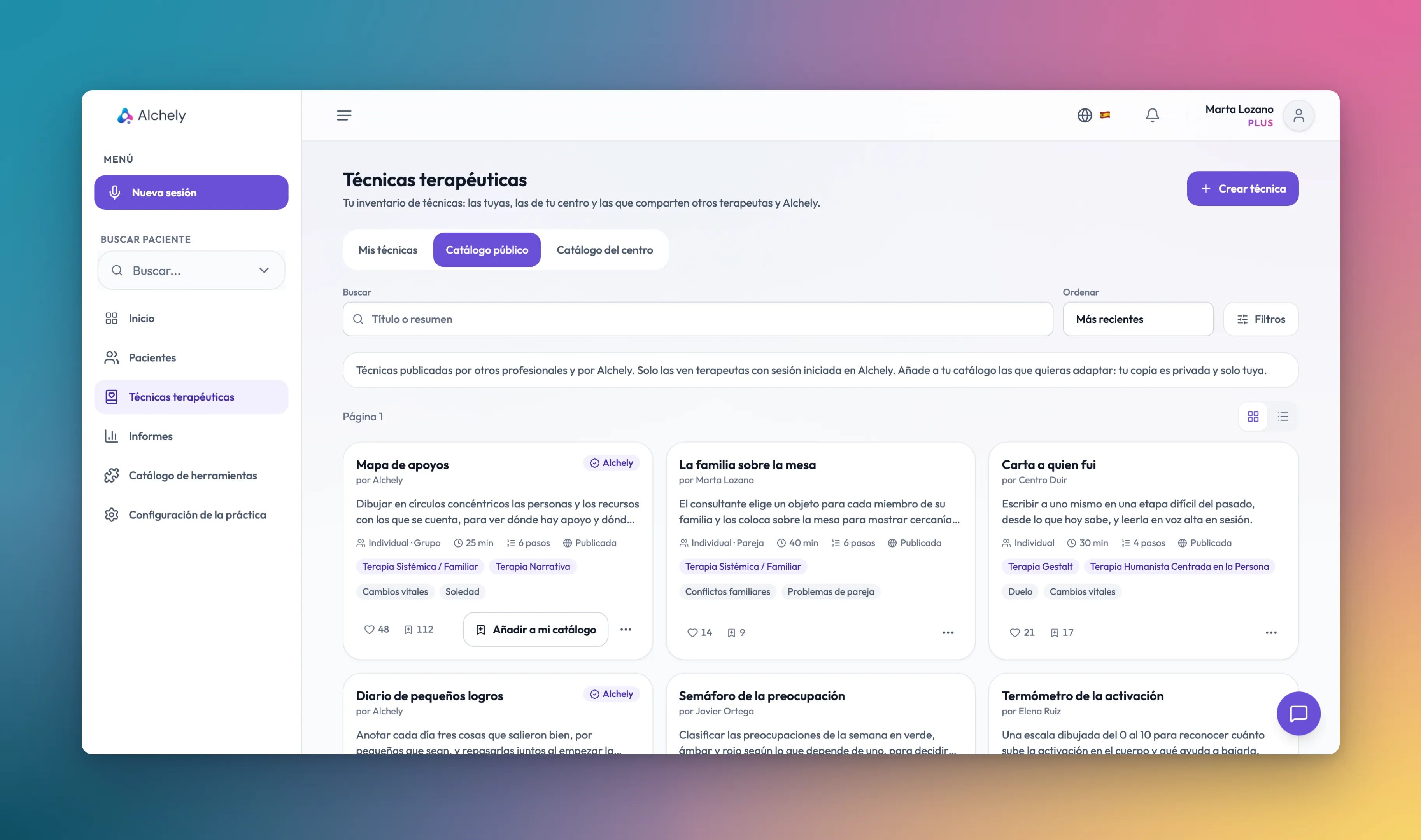
All in one place: your techniques, the public catalogue and, if you work in a centre, your centre's. To find the one you need, search by its name or by what its summary says, and filter by approach, by what it is for and by format: individual, couple or group.

The public catalogue of Therapeutic techniques in Alchely, as cards: techniques with the Alchely badge, one by the therapist herself, one from her centre and others published by other therapists, each with its format, duration, steps, approaches and presenting problems
The catalogues

Yours, your centre's and what others publish

My techniques holds the ones you wrote and the copies you took from other catalogues. The Public catalogue gathers those published by other therapists, by centres and by Alchely; there you can also filter by author and sort by most recent or most liked. You see them as cards or as a list, and each one opens in a preview or on its own full page.

Techniques written by Alchely carry its badge and are published under a CC BY-NC licence. They cannot be edited or deleted: to adapt one, add it to your catalogue and change your copy.
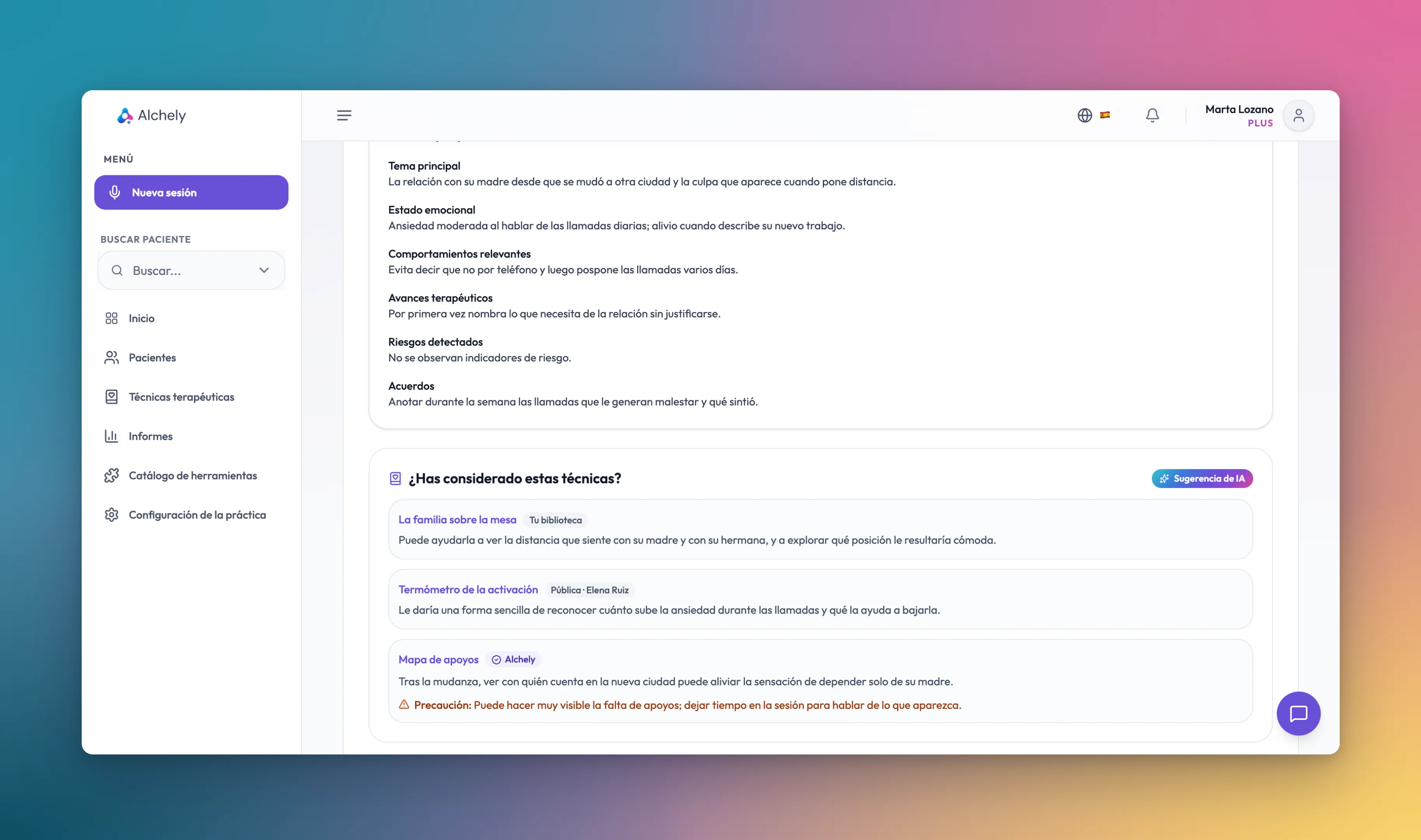
A session analysis in Alchely with the “Have you considered these techniques?” block, marked as an AI suggestion: one technique from the therapist’s library, one published by another therapist and one by Alchely, each with its reason and the last with a caution
After the session

The analysis suggests techniques you already have to hand

With Augmented Memory and AI consent from everyone in the session, the analysis brings the Have you considered these techniques? block: first up to three techniques from your catalogues, then the ideas that are not in them. Each carries its reason, tied to what happened in the session, a caution where it applies and where it comes from: Your library, Your centre, Public · author or the Alchely badge. In the recommendations for the next session, a suggested technique links to its record.

It is labelled AI suggestion, and the AI neither writes nor rewrites techniques: it only picks among those that exist and fit the session's format, never among anyone's private ones. Each technique goes to the model under an opaque reference, without its steps and anonymised, and what comes back is checked on the server.

Publishing and copying

Share yours, under your name and your licence

When you want to share a technique, click Publish…: you say who signs it and under which licence you share it. By default, all rights reserved.

If you like another therapist's technique, click Add to my catalogue and you get your own copy: private and ready to adapt your way, without losing who wrote it. And only therapists with an Alchely account can see the public catalogue: nothing is visible to anyone without one.

In a centre

One shared catalogue for the whole team

A centre's techniques are visible to its whole active team, therapists and mentors. Only the administrators create, edit and delete them, so a change reaches the whole team and nobody works from an old version.

Anyone who wants to adapt one adds it to their own catalogue. Administrators can also publish them to the public catalogue, by default with the centre's name as the author. More on teams in For centres.

Why use it

What changes when your techniques live where you work

It is not one more place to store documents: it is your repertoire, next to the sessions and notes where you use it.

Written once, always to hand

Steps, indications, contraindications and materials in the same record, found by approach, by presenting problem or by format.

Yours, even when it came from someone else

Copying takes a copy, not a link: you change it your way, and it still says who wrote it and under which licence.

One version across the centre

The whole team reads the same technique, and only the administrators change it. No stray versions passed round by email.

Suggestions that choose, not invent

With Augmented Memory, the analysis points to techniques that already exist in your catalogues, with its reason. The decision stays yours.

Private until you decide

Every new technique is yours alone. Publishing is a separate step, and what is published is seen only by signed-in therapists.

Frequently asked questions

Do I need a particular plan to use it?

No. It comes with every plan, free Basic included, and there is nothing to adopt: it sits in the sidebar as Therapeutic techniques, just above Reports, and on a phone in the tools sheet. Only the techniques suggested after a session need the Augmented Memory add-on.

Who sees the techniques I write?

Only you. Every new technique is private, and saving never publishes. If you decide to publish one, therapists with an account who are signed in to Alchely can see it: there is no techniques page anyone can open without an account. Withdrawing it from the public catalogue is always available, and copies others have already taken stay with whoever took them.

What happens when I copy another therapist's technique?

Add to my catalogue takes a copy, not a link. The copy is private and yours, you edit it as you like, and it still says who wrote it and under which licence. If you already have it, the button becomes Open my copy: copying twice duplicates nothing.

Which licences can I choose when publishing?

All rights reserved, the default, which only allows viewing and copying inside Alchely; CC BY, crediting the author; CC BY-NC, also non-commercial; CC BY-SA, sharing alike; and CC0, public domain. The licence travels with the technique and with every copy. Publishing also asks for an author: without a name to credit, nothing is published.

How does it work in a centre?

The centre catalogue is visible to the whole active team, therapists and mentors, and anyone can add a technique to their own catalogue to adapt it. Only the administrators create, edit and delete them, so a change is seen by the whole team. Administrators can also publish them to the public catalogue, by default with the centre's name as the author.

When does Augmented Memory suggest techniques?

Only with the Augmented Memory add-on active and with AI consent from everyone in the session, the same conditions the analysis already has. Then the Have you considered these techniques? block brings up to three techniques from your catalogues that fit the session's format, each with its reason, a caution where it applies and the catalogue it comes from. It is a suggestion, not a prescription: the decision and how you apply it stay yours.

What reaches the model from my techniques?

Each candidate technique goes with an opaque reference, without its steps, and with the text a therapist wrote passed through the same anonymiser as the notes. Other people's private techniques are never candidates. What the model returns is checked on the server, and a reference it was not offered is discarded: the AI only picks among techniques that exist, it never writes them.

Can I change Alchely's techniques?

Not directly: techniques written by Alchely carry its badge, are published under a CC BY-NC licence and cannot be edited or deleted. For now they are written in Spanish. To adapt one to the way you work, add it to your catalogue and change your copy.

Your techniques, next to your sessions and your notes

Write your first technique today: it is on the Basic plan, at no cost and with nothing to adopt.

Start free Read the guide